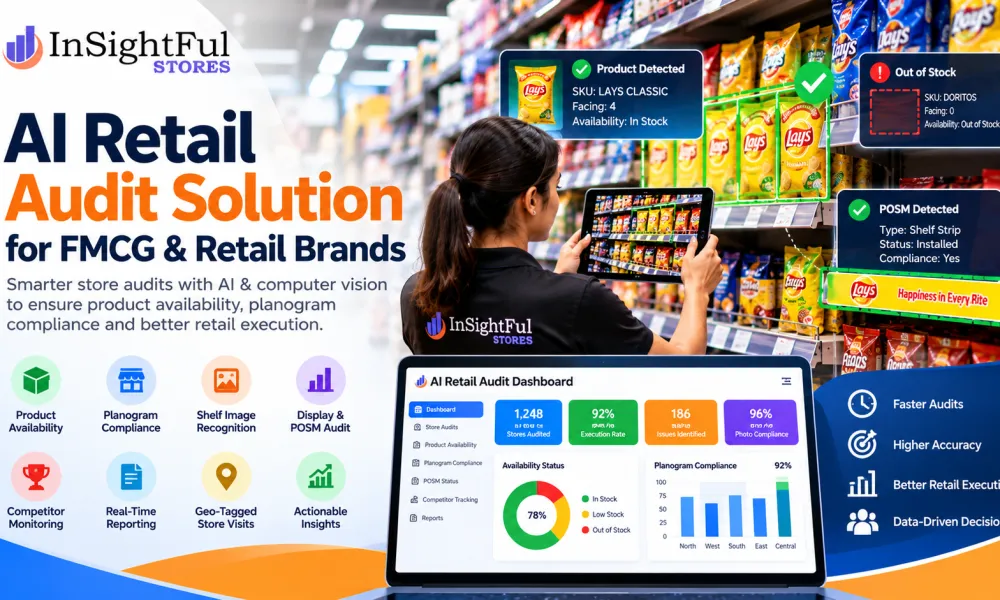
AI Retail Audit Solution: How Artificial Intelligence Is Transforming Retail Audits and Store Execution
Retail brands invest heavily in product distribution, merchandising, promotional displays, field teams and retail marketing campaigns.
But there is one critical question every brand needs to answer:
What is actually happening inside retail stores?
Are products available on the shelves?
Are merchandising guidelines being followed?
Are promotional displays installed correctly?
Are competitors gaining more shelf space?
Are products positioned according to approved planograms?
And are field employees reporting accurate information?
For brands operating across hundreds or thousands of retail outlets, answering these questions consistently can be difficult.
Traditional retail audits often depend on manual store visits, spreadsheets, photographs and supervisor verification.
Although these methods remain useful, they can become time-consuming and difficult to scale.
This is where an AI retail audit solution can help.
By combining artificial intelligence, computer vision, image recognition and retail analytics, AI-powered retail audit systems can automate parts of the store auditing process and provide brands with more structured information about retail execution.
For FMCG, FMCD, consumer electronics, beauty and other retail-focused businesses, this represents an opportunity to move from manual store inspection toward data-driven retail intelligence.
What Is an AI Retail Audit Solution?
An AI retail audit solution is a technology platform that uses artificial intelligence, computer vision and digital data collection to analyze retail store conditions, verify merchandising compliance and identify execution gaps.
Instead of relying entirely on manual observations, AI-enabled systems can analyze store photographs and other retail data to evaluate activities such as:
Product availability
Shelf arrangement
Planogram compliance
Product facings
Share of shelf
Promotional display presence
POSM compliance
Product placement
Competitor visibility
Stockout indicators
Retail execution quality
The system converts store-level observations into structured information that brand managers can review through dashboards.
In simple terms, an AI retail audit solution helps brands understand what is happening on retail shelves by turning store images and field data into measurable insights.
However, the capabilities depend on the specific software, image quality, product recognition models and integration with other business systems.
Why Do Retail Brands Need AI-Powered Retail Audits?
Modern retail operations are becoming increasingly complex.
A brand may operate across thousands of stores, multiple retail chains and different geographic markets.
Each location can have different shelf arrangements, stock conditions, merchandising requirements and competitor activity.
Traditional auditing methods can struggle with this scale.
1. Manual Retail Audits Take Time
Field employees may need to inspect shelves, count products, record stock availability, check promotional displays and complete multiple audit forms.
These activities can take considerable time, particularly when stores carry many SKUs.
AI-powered image analysis can automate some repetitive verification tasks.
2. Manual Reporting Can Be Inconsistent
Different employees may interpret merchandising guidelines differently.
One auditor may report a display as compliant, while another may identify a problem.
Standardized AI models can help apply consistent recognition rules, although human review is still required for uncertain cases.
3. Brands Need Faster Store-Level Visibility
When store reports are manually consolidated, management may receive information after the opportunity for corrective action has passed.
Digital reporting and automated analysis can reduce the time between data collection and management review.
4. Product Availability Is Difficult to Monitor
Products may be missing from shelves even when inventory exists elsewhere in the store.
Computer vision can help identify visible shelf gaps and missing products.
However, shelf images alone cannot establish total inventory availability without additional stock information.
5. Merchandising Compliance Is Hard to Verify at Scale
Brands often define detailed merchandising standards.
Verifying compliance across thousands of stores manually can be challenging.
AI-assisted audits can help compare actual shelf conditions against approved layouts and merchandising rules.
How Does an AI Retail Audit Solution Work?
An AI retail audit platform generally combines field data collection, image analysis and reporting.
The process can be divided into six stages.
AI-powered retail audit workflow
1. Store Visit & Image Capture
2. Image Upload & Quality Validation
3. AI Product & Display Recognition
4. Merchandising Compliance Analysis
5. Audit Dashboard & Exception Reporting
6. Corrective Action & Verification
Step 1: Store Image Capture
A merchandiser or field auditor visits the assigned store and captures photographs of shelves, displays or promotional materials through a mobile application.
Step 2: Image Processing
The system checks the uploaded images for technical requirements such as resolution, visibility and image quality.
Step 3: AI Image Recognition
Computer vision models analyze the images to identify recognizable products, shelf structures and display elements.
Step 4: Compliance Verification
Detected products and displays are compared with approved merchandising standards, product lists or planograms.
Step 5: Dashboard Reporting
The system generates structured audit information that can be reviewed by supervisors and brand managers.
Step 6: Corrective Action
Managers identify execution gaps and assign corrective actions to relevant field teams.
The process can then be repeated to verify whether the issues have been resolved.
Key Features of an AI Retail Audit Solution
Not every AI retail audit platform offers the same capabilities.
Brands should evaluate software based on their actual retail execution requirements.
1. AI-Based Product Recognition
Product recognition is one of the most important capabilities of computer vision retail auditing.
AI models can be trained to identify products from shelf photographs.
Depending on model accuracy and image conditions, the system may recognize:
Product brands
Product categories
Individual SKUs
Packaging formats
Product facings
Shelf positions
This can reduce the amount of manual product counting required during audits.
However, recognition accuracy can be affected by packaging similarities, poor lighting, occlusion and outdated product reference images.
2. Automated Shelf Auditing
Traditional shelf audits require field employees to manually inspect and record product placement.
AI shelf auditing can assist by analyzing photographs and identifying:
Product presence
Shelf arrangement
Empty shelf spaces
Product facings
Brand distribution
Display inconsistencies
This can make shelf auditing more standardized across multiple stores.
3. Planogram Compliance Monitoring
A planogram defines how products should be arranged on retail shelves.
An AI retail audit solution can compare observed shelf arrangements with approved planograms.
Depending on the platform, the analysis may include:
SKU positioning
Product sequence
Number of facings
Brand placement
Shelf allocation
Missing products
Incorrect placements
Brands can use this information to identify stores requiring merchandising corrections.
4. On-Shelf Availability Detection
One of the biggest challenges in retail execution is identifying products that are unavailable to shoppers.
AI systems can analyze shelf images to detect visible product absence or empty spaces.
For example, if a required SKU is missing from an expected shelf location, the system may flag the observation for verification.
It is important to distinguish on-shelf availability from total store inventory.
A product may be absent from the shelf but available in the back room.
Therefore, AI image analysis is most effective when combined with stock records and field verification.
5. Share of Shelf Measurement
Share of shelf measures how much retail shelf space a brand occupies compared with competing brands.
Computer vision can help estimate shelf allocation from photographs.
This may include:
Brand facings
Relative shelf occupancy
Product placement
Category visibility
The measurement methodology should be clearly defined because share of shelf may be calculated using facings, shelf width or another agreed metric.
6. POSM Compliance Verification
Point of Sale Materials are used to support brand communication and promotional execution.
AI-powered audits may help detect approved POSM elements such as:
Standees
Shelf strips
Promotional displays
Posters
Branded fixtures
Counter displays
Secondary displays
The system can help verify whether expected materials are visible in submitted images.
7. Competitor Visibility Analysis
Retail brands compete for limited shelf space.
AI-assisted audits can help collect structured observations about competitor product presence and placement.
Depending on the system, brands may analyze:
Competitor facings
Product presence
Shelf allocation
Display activity
Relative visibility
This can support retail planning and competitive intelligence.
8. Geo-Tagged Retail Audits
Geo-tagged audits connect store observations with location information.
Field applications may capture:
Store location
Employee check-in
Visit date
Visit time
Assigned outlet
Audit completion
This helps management verify field activities and organize audit data by location.
9. Automated Audit Scoring
AI retail audit platforms may calculate scores based on predefined compliance rules.
For example:
Audit Parameter | Illustrative Weight |
|---|---|
Product availability | 30% |
Planogram compliance | 25% |
Shelf visibility | 20% |
POSM execution | 15% |
Display condition | 10% |
These are illustrative weights, not an industry standard. Each brand should define its own scoring framework based on operational priorities.
10. Retail Analytics Dashboards
Dashboards help convert audit observations into management information.
A retail audit dashboard may include:
Stores audited
Audit completion rate
Product availability
Planogram compliance
Shelf share
POSM compliance
Regional performance
Outstanding issues
Corrective action status
Managers can use this information to identify execution patterns and prioritize interventions.
Traditional Retail Audit vs AI Retail Audit Solution
Traditional Retail Audits | AI-Powered Retail Audits |
|---|---|
Manual product identification | AI-assisted product recognition |
Manual shelf counting | Automated facing detection where supported |
Spreadsheet-based reporting | Centralized digital dashboards |
Manual planogram verification | Image-based compliance analysis |
Subjective observations | Standardized model-assisted checks |
Delayed report consolidation | Faster data processing |
Manual photo review | Automated image screening |
Limited scalability | Potentially scalable across large store networks |
Human-dependent analysis | AI-assisted analysis with human oversight |
AI should complement field auditors rather than be treated as a complete replacement for physical store verification.
AI Retail Audit Solutions for FMCG Brands
FMCG companies often manage extensive product portfolios across thousands of retail outlets.
Maintaining consistent execution can be challenging.
AI-powered retail audits can help monitor:
SKU availability
Product facings
Shelf placement
Planogram compliance
Secondary displays
POSM execution
Competitor presence
Shelf visibility
For example, an FMCG company may use store images to identify locations where required products are missing or merchandising standards are not being followed.
The findings can help field teams prioritize corrective action.
AI Retail Audits for Consumer Electronics and FMCD
Consumer electronics and durable goods often require detailed product presentation.
Retail audit requirements may include:
Demo-unit presence
Product display condition
Pricing labels
Feature communication
Promotional signage
Product availability
Display compliance
Computer vision can assist with certain visible conditions, while more complex checks—such as whether a demonstration unit functions correctly—still require additional testing or human verification.
AI Retail Audits for Beauty and Personal Care
Beauty and personal care brands often manage multiple product variants, shades and packaging formats.
AI-assisted retail audits may help with:
Product recognition
Shelf organization
SKU presence
Tester display verification
Promotional display monitoring
Planogram compliance
Because visually similar products can be difficult to distinguish, model training and accuracy validation are particularly important.
AI Retail Audits for Modern Trade and General Trade
AI retail audit requirements can differ between retail channels.
Modern Trade
Modern Trade stores often have standardized shelves and merchandising guidelines.
AI-assisted audits can help monitor:
Planogram compliance
Shelf arrangement
SKU availability
Product facings
POSM execution
Competitor visibility
General Trade
General Trade stores may have smaller, less standardized layouts.
AI-assisted auditing can still provide value, but image recognition may be more challenging because of:
Crowded shelves
Irregular product placement
Limited lighting
Different store formats
Partially hidden products
Brands should test AI models across representative GT outlets before deploying them at scale.
Benefits of AI Retail Audit Solutions
Faster Audit Processing
Automated image analysis can reduce the time required to process certain audit observations.
Improved Data Consistency
Standardized recognition models can help reduce differences between individual auditors.
Greater Retail Visibility
Brands can obtain structured information across stores, regions and retail chains.
Better Compliance Monitoring
AI-assisted analysis can help identify merchandising deviations from approved standards.
Scalable Store Auditing
Once validated, automated workflows may help organizations analyze larger volumes of retail images.
Faster Corrective Action
Digital reporting can help management identify issues earlier and assign them to relevant field teams.
Better Decision-Making
Retail audit data can help brands prioritize stores, regions and merchandising activities based on observed execution gaps.
Challenges of Implementing AI Retail Audit Software
Although AI-powered retail auditing offers potential benefits, implementation requires careful planning.
Image Quality
Poor lighting, blurred images and obstructed products can reduce recognition accuracy.
Product Database Maintenance
AI systems may require updated reference images when product packaging changes.
Similar Packaging
Products with similar labels or designs may be difficult to distinguish.
Store Layout Differences
Retail environments can vary significantly, especially across General Trade outlets.
Model Accuracy
Brands should validate precision, recall and SKU-level recognition performance before relying on automated audit results.
Integration Requirements
Retail audit software may need to integrate with field-force management, ERP, CRM or business intelligence systems.
Data Privacy and Security
Store photographs, employee locations and operational information should be collected and processed using appropriate permissions and safeguards.
Human Verification
Uncertain AI predictions and high-impact compliance decisions should be reviewed by qualified personnel.
How to Choose the Best AI Retail Audit Solution
Brands evaluating AI retail audit software should consider the following questions.
1. Does the platform support our product categories?
AI recognition capabilities should be tested on actual products and packaging.
2. Can it recognize individual SKUs?
Brand-level detection may not be sufficient for detailed merchandising audits.
3. Does it support planogram compliance?
Brands should verify how the platform compares observed shelf layouts against approved arrangements.
4. Can it handle real store conditions?
The system should be tested under different lighting, shelf layouts and image conditions.
5. Does it support offline field collection?
Offline capabilities may be important for stores with inconsistent internet connectivity.
6. Does it provide actionable dashboards?
The platform should present information relevant to business decisions.
7. Can it integrate with existing systems?
Integration may be necessary for stock, sales, employee and store information.
8. How are incorrect AI predictions handled?
The solution should provide a clear process for manual review and corrections.
9. What is the total implementation cost?
Costs may include licensing, image processing, integrations, model training, onboarding and ongoing support.
10. Can the solution scale across multiple regions?
Brands should assess performance across their actual retail network rather than relying only on a small demonstration.
Important KPIs for AI Retail Auditing
An AI retail audit program should measure both retail execution performance and AI system quality.
Retail KPI | Purpose |
|---|---|
Store audit completion rate | Measures planned vs completed audits |
On-shelf availability | Measures product presence |
Planogram compliance | Measures shelf layout adherence |
Share of shelf | Measures relative shelf allocation |
POSM compliance | Measures approved display execution |
Corrective action closure rate | Measures issue resolution |
Audit turnaround time | Measures reporting speed |
AI Performance KPI | Purpose |
|---|---|
Product recognition precision | Measures correctness of positive detections |
Product recognition recall | Measures how many actual products are detected |
SKU identification accuracy | Measures correct SKU classification |
Image rejection rate | Measures unusable submissions |
Manual review rate | Measures how often human intervention is needed |
Processing time per image | Measures analysis efficiency |
Tracking both sets of metrics helps brands determine whether AI is delivering reliable operational value.
AI Retail Audit Solution vs Retail Execution Software
These technologies are related but not identical.
Retail execution software manages broader field operations, including attendance, store visits, stock checks, promoter activities, merchandising and reporting.
AI retail audit software focuses on analyzing retail conditions, often using computer vision and automated compliance checks.
An integrated platform may combine both.
For example:
Field Employee → Store Visit → Shelf Photograph → AI Analysis → Retail Dashboard → Corrective Action
This creates a connected workflow between physical retail operations and automated analysis.
How AI Retail Audits Can Improve Merchandising Management
Retail merchandising teams are responsible for maintaining product presentation and availability.
AI-assisted auditing can support their work by identifying execution issues.
For example, a merchandising manager may receive reports showing:
Stores with missing SKUs
Locations with low planogram compliance
Outlets with incorrect displays
Regions with declining shelf presence
Stores requiring follow-up visits
Instead of manually reviewing every photograph, managers can focus on exceptions and corrective action.
This can help make merchandising management more efficient.
AI Retail Audit Solutions in India
India presents unique opportunities and challenges for AI-powered retail auditing.
Brands often operate across both organized Modern Trade and fragmented General Trade networks.
Store conditions can vary by region, city and retail format.
An AI retail audit solution designed for Indian retail environments should account for:
Different store layouts
Regional product assortments
Multiple packaging formats
Crowded shelves
Variable lighting
Different retailer standards
Multilingual field teams
Connectivity limitations
For successful implementation, brands should validate the technology across representative stores and markets.
A solution that performs well in a large supermarket may require additional training or configuration for smaller traditional outlets.
Insightful Stores: Technology-Enabled Retail Audits and Execution Support
For brands operating across large retail networks, technology is most useful when connected with structured field operations.
Insightful Stores provides managed retail and field-force services that support store-level execution, merchandising and reporting.
Its technology-enabled approach can support activities such as:
Store visit management
Geo-tagged attendance
Field employee monitoring
Merchandising audits
Product availability reporting
Stock tracking
Visibility reporting
POSM monitoring
Store-level data collection
Customized dashboards
Retail execution reporting
These capabilities can provide a foundation for more advanced image-based retail auditing.
For brands exploring AI-powered retail audits, combining field operations with suitable computer vision technology can create a more integrated execution model.
Note: AI product recognition, automated planogram scoring and computer vision capabilities should be presented as available Insightful Stores features only after confirming that the company currently offers them.
Why Consider Insightful Stores for Retail Audit Programs?
Insightful Stores combines field-force operations with technology-enabled reporting.
This approach can help brands coordinate:
Field Execution
Trained employees can collect store-level information and complete assigned audit activities.
Digital Monitoring
Geo-tagged attendance and structured store reporting provide greater operational visibility.
Merchandising Expertise
Retail field operations can support product availability, shelf visibility and execution audits.
Customized Reporting
Dashboards can be aligned with business-specific KPIs.
Scalable Operations
Coordinated field-force management can support audit programs across multiple stores and markets.
For brands evaluating AI-powered retail auditing, the next step is to determine how automated image analysis can integrate with existing field workflows.
The Future of AI-Powered Retail Auditing
AI retail auditing is likely to evolve toward more automated and predictive capabilities.
Potential developments include:
Improved SKU recognition
Automated shelf compliance scoring
More accurate product facing detection
Predictive identification of execution risks
Automated corrective action recommendations
Integration with inventory and sales systems
AI-generated retail performance summaries
Greater use of human-in-the-loop verification
The goal is not simply to automate image analysis.
It is to help brands connect store-level observations with faster and better-informed operational decisions.
Retail auditing plays an important role in maintaining product availability, merchandising compliance and consistent execution across physical stores.
However, manual auditing can become difficult to scale as retail networks grow.
An AI retail audit solution combines artificial intelligence, computer vision, digital data collection and analytics to automate selected audit activities and improve visibility into store-level conditions.
From product recognition and planogram compliance to shelf availability and POSM verification, AI-assisted auditing can help brands identify execution gaps more efficiently.
For FMCG, FMCD, consumer electronics, beauty and other retail-focused businesses, the strongest approach combines reliable technology, trained field teams, accurate data and human oversight.
The future of retail auditing is not simply digital.
It is increasingly intelligent, measurable and connected to business decisions.
Looking for an AI Retail Audit Solution in India?
Insightful Stores supports brands with technology-enabled retail execution, merchandising, store audits and field-force management services.
For businesses exploring AI-powered retail auditing, an integrated approach can combine structured store visits, image collection, field monitoring, reporting and suitable AI analysis capabilities.
Connect with Insightful Stores to discuss your retail audit requirements and explore how technology-enabled execution can support your store network.
Frequently Asked Questions About AI Retail Audit Solutions
What is an AI retail audit solution?
An AI retail audit solution is a technology platform that uses artificial intelligence, computer vision and digital reporting to analyze retail store conditions, verify merchandising compliance and identify execution gaps.
How does AI retail audit software work?
AI retail audit software typically analyzes photographs captured during store visits. Computer vision models identify products and display elements, compare observations with defined rules and generate structured audit results.
Can AI detect out-of-stock products?
AI can help detect missing products or empty shelf spaces from photographs. However, confirming total store inventory requires additional stock data or manual verification.
What is computer vision in retail auditing?
Computer vision is a branch of artificial intelligence that enables software to analyze images. In retail auditing, it can help recognize products, count facings, evaluate shelf arrangements and identify display elements.
Can AI check planogram compliance?
Yes. Suitable AI systems can compare observed shelf arrangements against approved planograms to identify missing products, incorrect placement and other compliance issues.
What industries can use AI retail audit solutions?
FMCG, FMCD, consumer electronics, beauty, food and beverage, CPG and other retail-focused businesses can use AI-assisted retail auditing.
What is the difference between AI retail audits and manual retail audits?
Manual audits depend primarily on human observations and reporting. AI retail audits automate selected analysis tasks, especially image-based product recognition and compliance checks, while still requiring human oversight.
How accurate is AI retail audit software?
Accuracy depends on the recognition models, product categories, image quality, store conditions and training data. Brands should evaluate the system using real store images and defined accuracy metrics before implementation.
Can AI retail audit software work in General Trade stores?
Yes, but performance can be affected by irregular shelf layouts, crowded displays, lighting conditions and product visibility. Testing across representative GT outlets is important.
What are the benefits of AI-powered retail audits?
Potential benefits include faster image processing, more standardized audits, improved retail visibility, easier compliance monitoring, scalable reporting and faster identification of execution gaps.