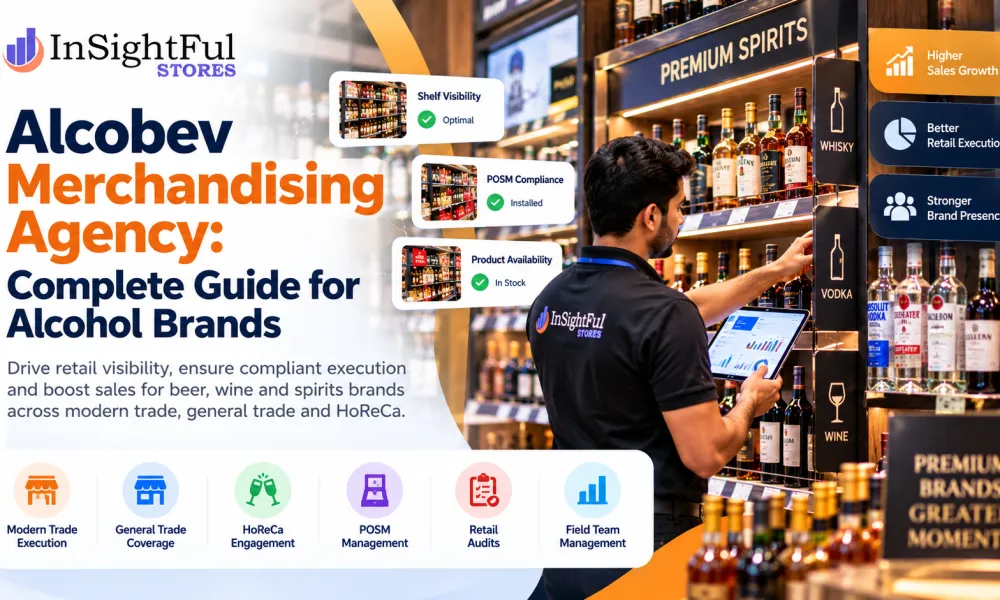
Alcobev Merchandising Agency: Complete Guide to Retail Visibility, Compliance and Store Execution in India
The Alcoholic Beverages (Alcobev) industry operates in one of the most complex retail environments.
Unlike many FMCG categories, alcoholic beverages face unique challenges involving state-specific regulations, distribution structures, retailer permissions, limited merchandising space and restrictions on promotional activities.
For beer, whisky, rum, vodka, gin, wine and other alcoholic beverage brands, success at retail depends on more than product availability.
Brands also need to understand:
Are products available in the right outlets?
Are approved products displayed in their designated locations?
Are shelf arrangements aligned with retailer requirements?
Are product prices and labels compliant with applicable regulations?
Are retail execution teams covering assigned outlets?
Are approved merchandising materials installed correctly?
Can management verify execution across multiple cities and states?
These challenges make professional Alcobev merchandising services an important operational capability for beverage companies.
An experienced Alcobev merchandising agency helps brands coordinate retail execution, monitor product availability, conduct visibility audits, manage field merchandising teams and maintain consistent execution within applicable regulatory requirements.
For alcohol beverage companies operating across multiple Indian markets, structured merchandising can help transform fragmented retail activities into measurable operations.
What Is an Alcobev Merchandising Agency?
An Alcobev merchandising agency is a specialized retail execution partner that helps alcoholic beverage brands manage product availability, shelf presentation, field merchandising, retail audits and permitted point-of-sale activities across licensed retail outlets.
Alcobev stands for Alcoholic Beverages and generally includes categories such as:
Whisky
Beer
Rum
Vodka
Gin
Wine
Brandy
Tequila
Other alcoholic beverage categories
Depending on the market and applicable regulations, an Alcobev merchandising agency may support:
Retail outlet coverage and field-force deployment
Product availability and stock monitoring
Shelf arrangement and display verification
Approved POSM installation and monitoring
Retail visibility audits
Competitor activity reporting
Geo-tagged store visits
Merchandiser attendance management
Store-level data collection
Performance dashboards and reporting
The objective is to provide Alcobev brands with greater visibility into their retail operations while respecting state excise laws, advertising restrictions and retailer-specific guidelines.
Why Is Alcobev Merchandising Different From FMCG Merchandising?
Alcoholic beverage merchandising shares some operational similarities with FMCG merchandising, but the regulatory environment can be significantly different.
India does not have one uniform retail framework for alcoholic beverages.
State governments regulate important aspects of alcohol distribution, retail sales, licensing, taxation and permitted promotional activity.
As a result, merchandising programs may require different approaches across states.
Key differences
Factor | FMCG Merchandising | Alcobev Merchandising |
|---|---|---|
Retail outlets | Supermarkets, kirana stores, hypermarkets | Licensed liquor stores and permitted hospitality channels |
Product display | Usually commercially flexible | Subject to applicable state and retailer rules |
Promotional materials | Generally permitted subject to relevant laws | May be restricted or prohibited |
Distribution | Multiple distribution models | Often state-regulated |
Pricing | Brand and retailer pricing structures | State-specific pricing and taxation requirements |
Field execution | General merchandising operations | Compliance-sensitive execution |
Retail audits | Stock, visibility and planograms | Availability, authorized visibility and compliance |
Campaign execution | Standard promotional planning | Requires market-specific legal review |
For Alcobev brands, effective merchandising must combine operational discipline with regulatory awareness.
Major Retail Merchandising Challenges in the Alcobev Industry
Alcoholic beverage brands often manage extensive retail networks with varying store formats, policies and operational conditions.
Several challenges can affect execution consistency.
1. Limited Retail Visibility
Many liquor retail outlets carry multiple competing brands within limited display space.
Premium, mainstream and economy products may compete for visibility across the same store.
Depending on applicable rules and retailer permissions, merchandising teams can help monitor whether products are arranged according to approved layouts.
The objective is not simply to increase promotional exposure, but to ensure that authorized product presentation is maintained.
2. Product Availability Gaps
A product may be listed with a retailer but unavailable at a particular outlet.
Possible reasons include:
Distribution delays
Inventory planning issues
Stock depletion
Supply restrictions
Incorrect store-level inventory information
Seasonal demand fluctuations
Merchandising teams can collect availability information and report gaps to the relevant sales and distribution teams.
3. Inconsistent Shelf Execution
Different retail outlets may have different layouts and storage arrangements.
This can make standardized shelf presentation difficult.
Field merchandising teams can document product placement and verify compliance with approved store-level guidelines.
4. Regulatory Complexity
Alcoholic beverage businesses must account for applicable state excise regulations and restrictions on advertising, promotion, display and sale.
A merchandising activity permitted in one market may be restricted in another.
Therefore, Alcobev merchandising programs should undergo appropriate legal and compliance review before implementation.
5. Fragmented Field Reporting
Brands operating across several states may receive information through spreadsheets, messages, calls and manually shared photographs.
This makes it difficult to maintain a consistent view of retail execution.
Technology-enabled reporting can help centralize authorized field information.
6. Limited Store-Level Intelligence
Management teams need to understand:
Which outlets carry the brand?
Which SKUs are available?
Which stores require attention?
Where are stock gaps occurring?
Are assigned visits being completed?
Are store-level guidelines being followed?
Without structured retail data, these questions can be difficult to answer consistently.
Key Services Offered by an Alcobev Merchandising Agency
A professional Alcobev merchandising agency can support multiple operational activities.
The exact service scope should depend on the brand's requirements and applicable market regulations.
1. Alcobev Retail Merchandising
Retail merchandising involves managing and monitoring how products are presented within authorized retail environments.
Activities may include:
Product arrangement verification
Shelf condition checks
SKU availability monitoring
Approved layout compliance
Store-level documentation
Product presentation audits
Reporting execution gaps
The objective is to maintain consistent and compliant retail presentation.
2. Liquor Store Merchandising Services
Liquor stores often differ significantly in layout, size and product assortment.
A merchandising program may therefore need to account for:
Store format
Available shelf space
Product category
Licensed retail conditions
Retailer guidelines
Product availability
Approved display arrangements
Field employees can help brands understand actual store conditions and report deviations from agreed execution standards.
3. Beer Merchandising Services
Beer merchandising can involve operational considerations such as stock rotation, product availability and, where applicable, refrigerated display conditions.
Field teams may monitor:
SKU availability
Stock levels
Product condition
Authorized shelf placement
Storage conditions
Expiry or best-before information where applicable
Store-level replenishment requirements
These activities can support operational consistency across retail outlets.
4. Wine and Spirits Merchandising
Wine and spirits categories may require different product handling and presentation standards.
Merchandising audits can examine:
Product availability
Bottle condition
Shelf arrangement
Price-label accuracy where applicable
Approved product categorization
Stock and display conditions
Brands can use this information to identify operational issues requiring attention.
5. Alcobev POSM Management
Point of Sale Materials (POSM) may be subject to significant restrictions in the alcoholic beverage category.
Where specific materials and activities are legally permitted, POSM management may include:
Requirement planning
Production coordination
Distribution
Installation verification
Condition monitoring
Compliance checks
Reporting
Examples of materials that may require regulatory approval include branded signage, shelf communication and display structures.
Important: POSM printing or deployment should never be treated as automatically permissible for alcoholic beverages. Each activity must be reviewed against applicable state regulations and retailer permissions.
6. Alcobev Retail Visibility Audits
Retail visibility audits help brands understand how their products are represented across licensed outlets.
Depending on legal permissions, audits may examine:
Product presence
SKU availability
Approved shelf placement
Product presentation
Display condition
Price-label accuracy
Store compliance
Competitor product presence
Stock gaps
These audits provide structured information for retail operations and management teams.
7. Merchandiser Recruitment and Deployment
Brands operating across multiple territories may require dedicated field employees.
A merchandising agency can help coordinate:
Recruitment
Screening
Training
Territory allocation
Store assignments
Attendance monitoring
Field supervision
Performance reporting
Replacement management
Training should cover both operational procedures and relevant compliance requirements.
8. Competitor Monitoring
Competitive intelligence can help brands understand product availability and market conditions.
Where legally permissible, field teams may collect factual information about:
Competitor SKU presence
Product availability
Shelf allocation
Listed prices
New product introductions
Store-level assortment
Data collection should respect retailer policies, applicable law and confidentiality requirements.
9. Geo-Tagged Store Visit Monitoring
For brands managing distributed field teams, verifying store visits is important.
Technology-enabled field applications can support:
Geo-tagged attendance
Check-in and check-out
Assigned store visits
Visit completion
Field activity reporting
Supervisor monitoring
This creates greater visibility into field-force operations.
10. Retail Reporting and Dashboards
Centralized dashboards can help management monitor retail execution.
Depending on the program, reporting may include:
Total assigned stores
Stores visited
Visit completion percentage
Product availability
SKU-level observations
Audit compliance
Field employee attendance
Outstanding issues
Territory performance
Structured reporting helps decision-makers identify operational priorities.
Technology-Enabled Alcobev Retail Execution
Traditional field operations often depend on manual reporting.
However, brands operating across large retail networks may benefit from digital field-force management systems.
A technology-enabled workflow can include:
Store Assignment → Geo-Tagged Check-In → Product Availability Check → Authorized Audit → Data Submission → Dashboard → Corrective Action
Mobile applications may support:
Store mapping
Employee attendance
Visit scheduling
Stock observations
SKU availability
Retail audit forms
Photo documentation where permitted
Expense management
Daily reporting
Supervisors and management can access consolidated information through dashboards.
Technology can improve the consistency and accessibility of field information, but it does not replace legal compliance checks or on-ground supervision.
Alcobev Merchandising for Different Retail Channels
Alcoholic beverage companies may operate through different permitted channels.
The merchandising approach should reflect the specific channel and applicable regulations.
Licensed Liquor Retail Stores
Field execution may focus on:
Product availability
SKU monitoring
Approved product presentation
Store-level observations
Stock-related reporting
Retail audit compliance
Premium Wine and Spirits Retail Outlets
Where permitted, merchandising may involve:
Product assortment checks
Shelf arrangement verification
Product condition
Availability reporting
Approved display compliance
Hotels, Restaurants and Bars
For authorized on-premise channels, operational programs may focus on:
Product availability
Approved inventory checks
Menu listing verification where permitted
Stock-related reporting
Outlet-level service coordination
The scope of field activities should be reviewed against licensing requirements and applicable regulations.
Important KPIs for Alcobev Merchandising
Measuring field activities is essential for understanding operational performance.
Important KPIs can include:
KPI | What It Measures |
|---|---|
Store coverage rate | Percentage of assigned outlets visited |
Visit completion rate | Completed visits against planned visits |
SKU availability | Availability of targeted SKUs |
Out-of-stock rate | Frequency of unavailable products |
Attendance compliance | Field employee attendance |
Audit compliance | Adherence to approved execution standards |
Reporting compliance | Timely completion of required reports |
Issue resolution time | Time taken to address reported problems |
Product presentation compliance | Adherence to approved shelf guidelines |
Territory performance | Execution results across assigned markets |
Brands should choose KPIs according to their operational objectives and legal obligations.
Benefits of Hiring a Professional Alcobev Merchandising Agency
Working with a specialized merchandising partner can provide several operational advantages.
1. Better Retail Visibility
Structured reporting helps brands understand product availability and approved presentation across outlets.
2. Consistent Field Execution
Defined workflows and training can improve execution consistency.
3. Scalable Operations
A merchandising agency can coordinate field teams across multiple territories without requiring brands to independently manage every operational process.
4. Improved Accountability
Geo-tagged visits, structured reporting and supervision can create clearer execution records.
5. Centralized Reporting
Management can access information across stores, cities and regions through standardized dashboards.
6. Faster Identification of Problems
Product availability gaps, missed visits and operational issues can be reported more systematically.
7. Better Operational Control
A coordinated management structure can simplify recruitment, training, deployment, supervision and reporting.
How to Choose the Right Alcobev Merchandising Agency in India
Selecting an Alcobev merchandising partner requires careful evaluation.
Brands should consider the following capabilities.
Industry understanding: Does the agency understand alcoholic beverage retail environments and operational requirements?
Regulatory awareness: Can it operate within relevant state-level restrictions and retailer guidelines?
Geographic coverage: Can it support the states and territories where the brand operates?
Field-force management: Does it have structured recruitment, training, deployment and supervision processes?
Technology: Can it provide geo-tagged attendance, store-level reporting and dashboards?
Retail audits: Can it perform approved product availability and merchandising audits?
Reporting: Can the agency provide data aligned with the brand's KPIs?
Operational flexibility: Can workflows be adapted for different states, retail formats and product categories?
Data governance: Does it maintain appropriate controls over field data, photographs and retailer information?
The best partner should offer a combination of operational capability, technology, retail experience and compliance awareness.
Alcobev Merchandising Agency vs General Merchandising Agency
A general merchandising agency may have experience across multiple consumer product categories.
An Alcobev merchandising agency requires additional awareness of the alcohol industry's regulatory and operational environment.
Capability | General Merchandising Agency | Alcobev-Focused Merchandising |
|---|---|---|
Shelf management | Yes | Yes, subject to permissions |
Stock monitoring | Yes | Yes |
Field employee management | Yes | Yes |
Store audits | Yes | Yes, with compliance controls |
POSM execution | Generally available | Restricted according to applicable law |
Regulatory understanding | General retail requirements | State-specific Alcobev requirements |
Licensed outlet operations | Not always required | Important |
Customized reporting | Often available | Important |
For Alcobev brands, regulatory compatibility should be considered alongside operational expertise.
How AI Can Support Alcobev Merchandising
Artificial intelligence and computer vision may offer opportunities to improve retail audit efficiency.
Potential applications include:
Product recognition from permitted store photographs
SKU identification
Shelf arrangement analysis
Product availability verification
Data anomaly detection
Automated reporting summaries
Field performance analysis
For example, where photography and data processing are permitted, a field employee could capture a shelf image during an authorized audit.
Computer vision could help identify products and compare the observed arrangement against approved reference data.
A possible workflow is:
Authorized Store Audit → Image Capture → AI Analysis → Human Verification → Compliance Report
AI-generated findings should be validated, especially where errors could affect compliance or operational decisions.
Insightful Stores: Alcobev Merchandising and Retail Execution Support in India
Managing field operations across multiple retail locations requires structured manpower management, retail expertise and reliable reporting.
Insightful Stores provides managed retail and field-force services that can support brands requiring coordinated store-level operations.
For Alcobev businesses, a tailored merchandising engagement could combine relevant capabilities such as:
Merchandiser recruitment and deployment
Territory-wise field-force management
Store visit planning
Geo-tagged attendance
Product availability reporting
Authorized retail audits
Store-level observations
Field supervision
Digital reporting
Customized dashboards
Any Alcobev-specific engagement should be scoped according to applicable state laws, retailer permissions and the brand's compliance requirements.
Why Consider Insightful Stores for Alcobev Retail Execution?
Insightful Stores' managed-services approach combines field operations with technology-enabled monitoring.
For brands evaluating merchandising support, this approach can help address several operational requirements.
Structured Field Management
Recruitment, deployment and supervision processes help coordinate distributed field teams.
Digital Monitoring
Technology-enabled attendance and store visit reporting can provide better operational visibility.
Retail Execution Experience
Experience managing retail field activities can support standardized processes and store-level reporting.
Customized Dashboards
Reporting can be designed around the brand's operational KPIs.
Integrated Operations
Field-force management, audits and retail reporting can be coordinated within one operating structure.
This approach can help Alcobev brands manage permitted retail activities more systematically.
Future of Alcobev Merchandising in India
The future of Alcobev merchandising is likely to place increasing emphasis on data quality, operational visibility and compliance-sensitive execution.
Brands need more than basic outlet visit information.
They need reliable answers to questions such as:
Which licensed outlets have our products?
Which SKUs are unavailable?
Are assigned store visits being completed?
Where are operational gaps occurring?
Are approved merchandising standards being followed?
Which territories require additional support?
How quickly are reported issues resolved?
Connecting field operations with technology can help management answer these questions more consistently.
The long-term opportunity lies in combining trained manpower, compliant retail execution, structured data and performance analytics.
Conclusion
The Alcobev industry presents unique retail execution challenges involving product availability, store-level presentation, regulatory restrictions and geographically distributed operations.
A professional Alcobev merchandising agency can help brands address these challenges through structured field-force management, authorized retail audits, product availability monitoring and technology-enabled reporting.
For beer, wine and spirits companies operating across multiple Indian markets, effective merchandising requires more than occasional store visits.
It requires a coordinated approach involving:
Planning → Compliance Review → Field Deployment → Store Monitoring → Data Collection → Reporting → Corrective Action
By combining operational expertise with digital visibility, brands can gain greater control over retail execution while maintaining appropriate regulatory safeguards.
Looking for an Alcobev Merchandising Agency in India?
Insightful Stores offers technology-enabled retail field-force management and execution services for brands operating across multiple markets.
For Alcobev companies evaluating retail merchandising support, a customized engagement can focus on authorized store visits, field-team management, product availability monitoring, retail audits and performance reporting.
Connect with Insightful Stores to discuss a compliance-sensitive Alcobev merchandising program aligned with your retail network and operational requirements.
Frequently Asked Questions About Alcobev Merchandising Agencies
What is an Alcobev merchandising agency?
An Alcobev merchandising agency is a retail execution service provider that helps alcoholic beverage brands manage field merchandising teams, product availability monitoring, authorized retail audits and store-level reporting.
What does Alcobev stand for?
Alcobev stands for Alcoholic Beverages. It is an industry term covering products such as beer, wine, whisky, rum, vodka, gin, brandy and other alcoholic drinks.
Why do alcohol brands need merchandising services?
Alcohol brands may require merchandising services to monitor product availability, maintain approved store-level presentation, manage field teams and collect consistent retail execution data.
What services does an Alcobev merchandising company provide?
Services can include merchandiser recruitment, field-force deployment, store visits, SKU availability tracking, retail audits, attendance management, competitor monitoring and reporting, subject to applicable legal requirements.
Are POSM activities allowed for alcohol brands in India?
POSM permissions depend on applicable state regulations, the type of material, the location and the nature of the activity. Brands should obtain appropriate legal and regulatory review before undertaking POSM production or deployment.
How can technology improve Alcobev merchandising?
Technology can support geo-tagged attendance, digital store visits, structured audit forms, product availability reporting, field supervision and centralized dashboards.
What are the important KPIs for Alcobev merchandising?
Important KPIs include store coverage, visit completion, SKU availability, out-of-stock rate, attendance compliance, audit compliance, issue resolution time and reporting accuracy.
How do I choose an Alcobev merchandising agency in India?
Evaluate the agency's retail experience, geographic coverage, regulatory awareness, recruitment capabilities, field monitoring, technology, reporting systems and ability to manage compliance-sensitive operations.
Can an Alcobev merchandising agency operate across multiple Indian states?
An agency may coordinate operations across multiple states, but activities must be adapted to each state's applicable laws, retailer permissions and operational requirements.
What is the difference between Alcobev merchandising and retail marketing?
Alcobev merchandising focuses on store-level operational activities such as availability monitoring, authorized product presentation and field reporting. Retail marketing is a broader function that may include brand communication and promotional planning, subject to applicable alcohol advertising restrictions.