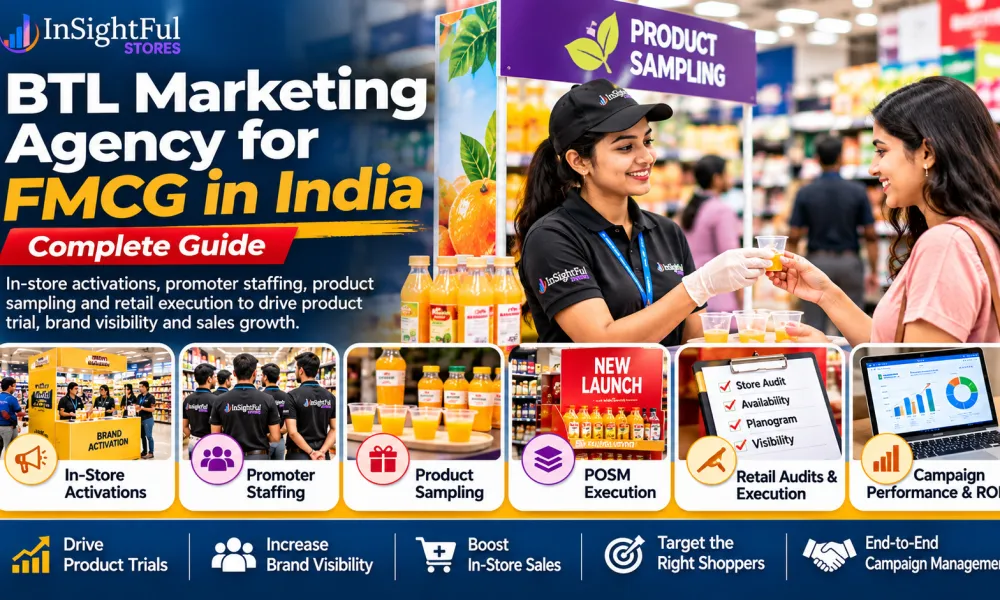
BTL Marketing Agency for FMCG: Strategies, Services & Benefits for Retail Brands in India
The FMCG industry is one of the most competitive consumer markets in India.
From packaged foods and beverages to personal care, home care, beauty, and hygiene products, hundreds of brands compete for consumer attention across supermarkets, hypermarkets, kirana stores, and other retail channels.
While digital advertising and mass media campaigns help brands build awareness, the final purchase decision often takes place much closer to the product itself.
A shopper may recognize a brand from an advertisement but still choose a competitor after entering a store.
Product availability, shelf placement, promotional offers, product demonstrations, and interactions with trained promoters can all influence that decision.
This is where a BTL marketing agency for FMCG becomes valuable.
Below-the-line (BTL) marketing focuses on targeted promotional activities that connect brands with specific consumer groups through direct interactions, retail activations, product sampling, demonstrations, and other measurable campaigns.
For FMCG brands, a well-planned BTL strategy can help bridge the gap between brand awareness and actual retail execution.
However, successful BTL marketing requires more than placing promoters inside stores or distributing product samples.
Brands need a structured approach that combines campaign planning, trained manpower, retailer coordination, product availability, execution monitoring, and performance reporting.
This guide explains how FMCG BTL marketing works, the services agencies provide, practical activation strategies, campaign costs, performance metrics, and how to select the right BTL marketing partner in India.
What Is BTL Marketing in FMCG?
BTL marketing in FMCG refers to targeted marketing activities designed to engage consumers directly, encourage product trials, communicate product benefits, and support purchase decisions through specific retail or experiential touchpoints.
Unlike broad mass-media advertising, BTL marketing generally focuses on identifiable locations, audiences, or customer interactions.
Common FMCG BTL activities include:
In-store product demonstrations
Product sampling campaigns
Retail brand activations
Trained promoter deployment
Mall and kiosk activations
Modern Trade promotional campaigns
General Trade retailer engagement
Consumer awareness activities
Experiential marketing events
Authorized POSM installation
New product launch activations
Retail-level promotional execution
For example, a packaged food brand launching a new snack may organize product sampling in selected supermarkets.
Trained promoters can explain the product, offer samples where permitted, collect appropriate feedback, and support the campaign's objectives.
The goal is to create relevant consumer interactions that can be measured and improved.
What Does a BTL Marketing Agency for FMCG Do?
A BTL marketing agency for FMCG plans, coordinates, executes, and measures targeted brand activation campaigns across retail stores and other consumer touchpoints.
Depending on the project, an agency may handle:
Campaign strategy and planning
Target market and location selection
Promoter recruitment and deployment
Product training
Retailer permissions and coordination
Sampling and demonstration activities
POSM installation and monitoring
Field supervision
Digital attendance and activity reporting
Campaign performance measurement
A suitable agency helps brands manage the operational complexity of running activations across multiple locations.
For nationwide FMCG campaigns, this may involve coordinating hundreds of promoters, supervisors, retailers, and field activities.
Why BTL Marketing Is Important for FMCG Brands
1. Direct Consumer Engagement
BTL marketing creates opportunities for direct interaction between consumers and brand representatives.
Unlike passive advertising, consumers can ask questions, understand product features, and receive immediate information.
This is especially useful for new or unfamiliar products.
2. Product Trial and Demonstration
For suitable categories, product sampling allows consumers to experience a product before purchasing it.
Examples include food tasting, beverage sampling, personal care demonstrations, and product-use demonstrations.
Sampling should follow applicable hygiene, safety, retailer, and category-specific requirements.
3. Support for New Product Launches
Launching a new FMCG product involves more than distribution.
Consumers need to discover the product, understand its value, and recognize how it differs from existing alternatives.
BTL activations can support product education during the launch period.
4. Localized Marketing Execution
Different cities, retail formats, and consumer groups may respond differently to promotional activities.
BTL marketing allows brands to tailor campaign locations, languages, and activities to local market conditions.
5. Measurable Field Activities
Brands can monitor campaign execution through metrics such as:
Stores activated
Promoter attendance
Consumer interactions
Samples distributed
Demonstrations completed
Product availability
Campaign costs
Verified sales outcomes
However, activity metrics alone do not establish incremental sales impact.
6. Stronger Retail Coordination
BTL programs often require close coordination with retailers, merchandising teams, and distribution partners.
This can help identify operational issues that affect campaign execution.
12 Essential BTL Marketing Services for FMCG Brands
1. In-Store Brand Activation
In-store brand activation involves organizing targeted brand activities within retail outlets.
These campaigns may include product education, demonstrations, sampling, and approved promotional communication.
For example, a personal care brand may deploy trained promoters in selected hypermarkets to explain a newly launched product range.
A successful activation requires:
Retailer permission
Suitable store selection
Trained staff
Available products
Approved promotional materials
Clear performance targets
Reliable reporting
Business benefit: More structured consumer engagement at relevant retail touchpoints.
2. FMCG Promoter Staffing and Management
Promoters are responsible for representing brands and communicating product information to shoppers.
Depending on the campaign, their responsibilities may include:
Product demonstrations
Shopper interactions
Product education
Sampling activities
Campaign reporting
Feedback collection
Product availability observations
An agency may manage recruitment, onboarding, training, attendance, supervision, and replacements.
Business benefit: Centralized management of distributed promotional manpower.
3. Product Sampling Campaigns
Product sampling allows consumers to try suitable products before making a purchase decision.
Sampling is commonly considered for categories such as:
Packaged foods
Non-alcoholic beverages
Snacks
Personal care
Selected household products
The activity must be appropriate for the product and conducted according to safety and retailer requirements.
A sampling program should measure more than the number of samples distributed.
Relevant metrics include eligible shopper interactions, trial completion, cost per trial, and incremental sales where measurable.
Business benefit: Opportunities for product experience and feedback.
4. Modern Trade BTL Activation
Modern Trade includes organized retail formats such as supermarkets, hypermarkets, and retail chains.
BTL activities in Modern Trade may include:
In-store promoter deployment
Approved sampling counters
Product demonstrations
New launch activations
Promotional display monitoring
Shopper engagement activities
These campaigns generally require coordination with retailer management and compliance with store-specific operating procedures.
Business benefit: Structured activation execution within organized retail networks.
5. General Trade Activation
General Trade includes traditional retail formats such as kirana stores and independent outlets.
Because these outlets vary in size and layout, campaigns often require localized planning.
General Trade BTL activities may involve:
Retailer engagement
Approved product communication
New product introduction
Outlet-level visibility checks
Local market activation
Retailer education
Campaign reporting
Business benefit: Wider local-market coverage through adaptable activation programs.
6. Mall and Kiosk Activation
Malls and retail kiosks can provide controlled environments for product demonstrations and consumer engagement.
A typical kiosk activation may involve:
Branded kiosk setup
Trained promoters
Product demonstrations
Interactive activities
Approved sampling
Lead or feedback collection with appropriate consent
The campaign design should align with the product category, venue permissions, and target audience.
Business benefit: Focused consumer interactions at selected locations.
7. New Product Launch Campaigns
A new product launch can benefit from coordinated BTL execution.
A launch activation program may include:
Identifying target markets
Selecting stores
Training promoters
Confirming stock availability
Installing approved campaign materials
Conducting demonstrations
Recording interactions
Measuring campaign outcomes
Business benefit: Structured support for product awareness, education, and trial during launch.
8. POSM Printing and Management
Point of Sale Materials (POSM) are used to communicate product information and support approved retail displays.
Common materials include:
Shelf strips
Danglers
Standees
Wobblers
Counter displays
Floor graphics
Promotional posters
Branded display units
POSM management may involve printing, distribution, installation, maintenance, and verification.
Business benefit: Better control over approved in-store communication materials.
9. Experiential Marketing Campaigns
Experiential marketing allows consumers to interact with products or brands through designed activities.
Examples may include:
Interactive product demonstrations
Consumer participation activities
Brand experience zones
Product education sessions
Themed activation booths
The objective is to create relevant product experiences rather than relying only on passive advertising.
Business benefit: Opportunities for deeper product understanding and engagement.
10. Retail Merchandising Support
BTL activities can be affected by poor merchandising execution.
For example, a promoter may generate consumer interest in a product that is unavailable on the shelf.
Retail merchandising support may include:
Product availability checks
Shelf arrangement monitoring
POSM verification
Stock gap reporting
Retail execution audits
Corrective action coordination
Business benefit: Better coordination between promotional activities and store readiness.
11. Field Supervision and Campaign Monitoring
Multi-location BTL campaigns require reliable field supervision.
Supervisors may be responsible for:
Verifying promoter attendance
Reviewing campaign execution
Checking product availability
Coordinating with store managers
Resolving operational issues
Reviewing daily reports
Escalating campaign deviations
Business benefit: Improved operational accountability.
12. Technology-Enabled BTL Reporting
Digital reporting platforms can support campaign management across multiple stores and cities.
Potential capabilities include:
Geo-tagged attendance
Store visit verification
Digital activity forms
Photo documentation
Sample distribution tracking
Consumer interaction reporting
Supervisor approval
Issue management
Performance dashboards
Business benefit: More consistent campaign monitoring and reporting.
ATL vs BTL vs TTL Marketing in FMCG
FMCG brands often combine different marketing approaches.
Factor | ATL Marketing | BTL Marketing | TTL Marketing |
|---|---|---|---|
Full form | Above the Line | Below the Line | Through the Line |
Primary focus | Broad awareness | Targeted engagement | Integrated marketing |
Typical channels | TV, radio, broad-reach media | Sampling, activations, demonstrations | Coordinated mass and targeted channels |
Audience | Broad | Defined groups or locations | Multiple audience segments |
Measurement | Reach, awareness, brand lift | Interactions, trials, incremental sales | Combined brand and commercial KPIs |
FMCG example | National television campaign | Supermarket product sampling | TV campaign supported by in-store activation |
For example, a beverage brand may launch a national awareness campaign and simultaneously run sampling activities in selected supermarkets.
The integrated approach can help connect broad awareness with product-level engagement.
How to Plan a Successful FMCG BTL Marketing Campaign
A well-executed BTL campaign should follow a structured process.
FMCG BTL activation workflow
Define Campaign Objectives
Identify Target Consumers & Markets
Select Stores & Activation Locations
Plan Budget, Permissions & Logistics
Recruit and Train Promoters
Execute Campaign Activities
Monitor Attendance & Field Reporting
Measure Results & Optimize
Step 1: Define Clear Campaign Objectives
Decide what the campaign should achieve.
Possible objectives include product trials, shopper education, new product awareness, incremental sales, or retailer engagement.
Avoid using one KPI for every objective.
Step 2: Identify the Target Audience
Understand the intended consumer group, shopping behavior, geographic markets, and relevant retail formats.
Step 3: Select Activation Locations
Choose stores or venues based on category relevance, shopper traffic, retailer permissions, logistics, and expected business value.
Step 4: Create the Campaign Budget
Include staffing, training, travel, materials, sampling, permissions, supervision, and reporting costs.
Step 5: Recruit and Train Promoters
Train promoters on product information, customer communication, campaign procedures, and applicable compliance requirements.
Step 6: Confirm Store Readiness
Check product availability, retailer approvals, equipment, promotional materials, and operational arrangements.
Step 7: Execute and Monitor
Use field supervisors and digital reporting to verify campaign activities.
Step 8: Evaluate Performance
Review execution KPIs, costs, shopper engagement, and incremental commercial outcomes.
How Much Does BTL Marketing Cost for FMCG Brands in India?
BTL campaign costs depend on the campaign scope, geography, staffing requirements, duration, and operational complexity.
The main cost components may include:
Cost Component | What It Covers |
|---|---|
Campaign planning | Strategy, location selection, execution planning |
Promoter staffing | Compensation, recruitment, onboarding |
Training | Product and campaign training |
Travel and logistics | Movement of people, materials, and equipment |
Sampling products | Product units allocated for consumer trials |
POSM | Printing, distribution, installation |
Venue permissions | Applicable retailer or venue charges |
Supervision | Field coordinators and campaign managers |
Technology | Attendance, activity reporting, dashboards |
Agency management | Program coordination and administrative services |
Contingency | Approved allowance for unforeseen requirements |
A campaign across five stores for one weekend will have a very different cost structure from a multi-city program operating for several months.
Brands should request a detailed commercial proposal and compare fully loaded costs rather than promoter salaries alone.
How to Measure FMCG BTL Marketing ROI
BTL marketing should be evaluated using both execution and business performance metrics.
Important BTL Marketing KPIs
KPI | What It Measures |
|---|---|
Stores activated | Number of locations where campaigns were executed |
Promoter attendance | Completed shifts versus scheduled shifts |
Consumer interactions | Relevant shopper engagements |
Samples distributed | Verified sampling activity |
Demonstration completion | Number of completed demonstrations |
Trial-to-purchase conversion | Purchases associated with eligible product trials |
Cost per interaction | Campaign cost divided by qualified interactions |
Cost per trial | Campaign cost divided by completed trials |
Incremental sales | Additional sales attributable to the campaign |
Incremental contribution | Incremental revenue less relevant variable costs |
Campaign ROI | Net incremental contribution relative to investment |
FMCG BTL Marketing ROI Formula
Example: FMCG BTL Campaign ROI
Consider a hypothetical product activation program.
Metric | Illustrative Value |
|---|---|
Stores activated | 25 |
Campaign duration | 30 days |
Total campaign cost | ₹5,00,000 |
Estimated incremental sales | ₹20,00,000 |
Contribution margin | 35% |
Incremental contribution | ₹7,00,000 |
Net incremental return | ₹2,00,000 |
Estimated ROI | 40% |
Calculation:
This is a hypothetical illustration, not a real Insightful Stores campaign result or an industry benchmark.
The incremental sales figure should ideally be established through matched control stores, randomized testing, or another credible attribution method.
Simply comparing sales before and after an activation may overstate the campaign's impact.
Common Challenges in FMCG BTL Marketing
Inconsistent Campaign Execution
Different locations may follow different procedures.
Solution: Use standardized training, checklists, supervision, and reporting.
Promoter Absenteeism
Missing shifts can reduce planned activation coverage.
Solution: Use attendance verification and defined replacement procedures.
Product Stockouts
A campaign may create product interest when the product is unavailable.
Solution: Confirm stock availability before activation and monitor replenishment.
Poor Sampling Management
Untracked samples can create inventory and reporting problems.
Solution: Maintain sampling records and reconcile distributed quantities.
Limited Visibility Across Locations
Large campaigns can be difficult to monitor through disconnected messages and spreadsheets.
Solution: Centralize activity reporting and issue tracking.
Inaccurate ROI Measurement
Total sales or interaction counts may be mistaken for incremental business impact.
Solution: Separate activity reporting from causal sales measurement.
BTL Marketing Strategies for Different FMCG Categories
FMCG Category | Suitable BTL Activities | Key Considerations |
|---|---|---|
Packaged foods | Product sampling, demonstrations | Hygiene, trial measurement, stock availability |
Non-alcoholic beverages | Sampling, product education | Temperature, sampling logistics, store permissions |
Personal care | Product demonstrations, promoter interactions | Product suitability, accurate claims |
Home care | Usage demonstrations, product education | Safety instructions, demonstration suitability |
Beauty products | Product education, permitted tester demonstrations | Hygiene, trained staff, tester maintenance |
Baby care | Product information and education | Careful claims, safety, appropriate communication |
New FMCG launches | Multi-store activations, shopper education | Availability, trial, incremental sales measurement |
Activities should be tailored to the category, retailer requirements, and applicable advertising and consumer protection rules.
How to Choose the Best BTL Marketing Agency for FMCG in India
Selecting an agency involves more than comparing quotations.
Brands should evaluate the provider's ability to deliver consistent execution and measurable reporting.
1. FMCG Industry Experience
Does the agency understand the specific requirements of packaged foods, personal care, home care, beverages, or other relevant categories?
2. Geographic Coverage
Can the agency support the cities, states, and retail networks included in your campaign?
3. Promoter Recruitment and Training
Does it have structured processes for recruitment, onboarding, and replacement?
4. Retailer Coordination
Can the agency manage the operational requirements and permissions of relevant stores?
5. Field Supervision
How does the provider verify execution and resolve problems?
6. Technology and Reporting
Can the agency provide store-level attendance, activity records, and useful campaign dashboards?
7. Campaign Measurement
Does the agency distinguish between activity metrics, recorded sales, and incremental sales?
8. Cost Transparency
Does the quotation include staffing, training, logistics, management, technology, and applicable additional charges?
9. Compliance and Safety
Does the agency follow relevant labor, consumer, product safety, and venue requirements?
10. References and Case Studies
Can it provide relevant, verifiable examples of previous work?
A strong agency should be able to explain not only how a campaign will be executed but also how its success will be measured.
How Insightful Stores Can Support FMCG BTL Marketing Execution
Running multi-location BTL campaigns requires coordinated field manpower, operational planning, retail execution, and consistent reporting.
Insightful Stores provides technology-enabled retail and field-force management services that can support several operational components of FMCG activation programs.
Relevant capabilities include:
Promoter recruitment and deployment
Field-force management
Training and onboarding coordination
Store-level visit planning
Geo-tagged attendance monitoring
Retail merchandising support
Product availability reporting
POSM execution monitoring
Field supervision
Digital activity reporting
Customized performance dashboards
These capabilities can support brands seeking structured in-store activation and retail execution management.
Why Consider Insightful Stores for FMCG BTL Programs?
Managed field operations: Coordinate promoter deployment and store-level activities through defined processes.
Retail execution support: Connect activation programs with product availability and merchandising observations.
Technology-enabled monitoring: Improve visibility into attendance, field activities, and campaign reporting.
Customized performance reporting: Track operational KPIs relevant to the campaign's objectives.
Scalable campaign planning: Define deployment according to store networks, geography, and business requirements.
Specific activation services, sampling arrangements, geographic coverage, and campaign responsibilities should be confirmed during project scoping.
Future Trends in FMCG BTL Marketing
BTL marketing is becoming increasingly connected with retail technology, data, and integrated campaign measurement.
Potential developments include:
1. Digital Field Reporting
Mobile reporting platforms can make campaign monitoring more consistent.
2. Data-Driven Store Selection
Brands can use historical sales, traffic, and retail performance data to select activation locations.
3. AI-Assisted Campaign Planning
Analytics tools may help identify store clusters, staffing requirements, and deployment opportunities.
4. Integrated Retail Execution
Brands can connect promoter activity reporting with product availability, POSM, and merchandising data.
5. Better Incrementality Measurement
Controlled tests and retailer sales data can help brands estimate the actual contribution of activation programs.
6. Localized Consumer Engagement
Campaigns can be adapted to regional languages, shopping patterns, and retail environments.
The strongest BTL programs will continue to depend on trained employees, effective planning, retailer coordination, and reliable measurement.
A professional BTL marketing agency for FMCG can help brands plan and coordinate targeted consumer engagement activities across retail stores and other relevant locations.
From product sampling and in-store demonstrations to promoter deployment, retail merchandising, and digital reporting, BTL marketing brings brand communication closer to the point of purchase.
However, successful activation depends on more than the number of promoters deployed or samples distributed.
Brands need the right stores, trained field teams, available products, standardized execution, transparent reporting, and credible measurement of incremental outcomes.
For FMCG companies operating across multiple retail formats in India, combining BTL activation planning with technology-enabled field-force management can support more consistent campaign execution.
Looking for a BTL Marketing Agency for FMCG in India?
Insightful Stores supports retail brands with promoter deployment, field-force management, merchandising operations, and technology-enabled store reporting.
Whether your brand is planning a new product launch, in-store activation, or multi-location promotional campaign, structured field operations can help improve execution visibility and accountability.
Contact Insightful Stores to discuss your FMCG BTL activation and promoter management requirements.
Frequently Asked Questions About BTL Marketing Agencies for FMCG
What is a BTL marketing agency for FMCG?
A BTL marketing agency for FMCG plans and executes targeted marketing activities such as in-store activations, product demonstrations, sampling campaigns, promoter deployment, and retail-level consumer engagement.
What is BTL marketing in FMCG?
BTL marketing in FMCG refers to targeted promotional activities designed to engage consumers directly through retail stores, sampling, demonstrations, events, and other specific touchpoints.
What are examples of BTL marketing activities?
Examples include product sampling, supermarket activations, promoter campaigns, mall kiosks, consumer demonstrations, retailer engagement, and new product launch activities.
How is BTL marketing different from ATL marketing?
ATL marketing generally focuses on broad-reach advertising, while BTL marketing emphasizes targeted engagement and specific consumer touchpoints.
Why do FMCG brands use BTL marketing?
FMCG brands use BTL marketing to support product education, consumer trials, new launches, targeted engagement, and retail-level execution.
How much does a BTL marketing agency cost in India?
Costs depend on campaign duration, staffing, cities, stores, sampling requirements, materials, logistics, and management arrangements. A detailed scope is needed for an accurate quotation.
How do FMCG brands measure BTL marketing ROI?
Brands can estimate ROI by comparing incremental contribution generated by a campaign against its fully loaded cost, ideally using controlled sales measurement.
What is the role of promoters in BTL marketing?
Promoters interact with shoppers, communicate product information, conduct approved demonstrations, support sampling activities, and submit campaign reports.
Can BTL marketing support new FMCG product launches?
Yes. BTL campaigns can support new launches through product education, demonstrations, sampling, and targeted retail engagement.
What should brands look for in a BTL marketing agency?
Important factors include FMCG experience, geographic coverage, promoter management, field supervision, technology-enabled reporting, compliance, cost transparency, and verifiable campaign results.