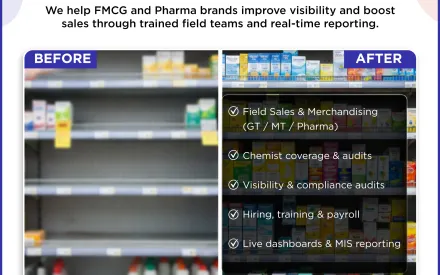
Introduction: -
In today’s competitive FMCG and retail environment, many
brands believe that increasing distribution automatically guarantees higher
sales. However, reality tells a different story.
A product may be present in thousands of stores, yet sales
remain stagnant. The reason? The Distribution vs Execution Gap — a
silent revenue killer affecting brands across General Trade (GT) and Modern
Trade (MT).
Let’s understand what this gap is and how it directly impacts your sales growth.
What is Distribution?
Distribution refers to how widely your product is
available in the market.
There are two key types:
- Numeric
Distribution – Number of stores where the product is available.
- Weighted
Distribution – Availability in high-selling or high-footfall stores.
Example:
If your product is listed in 5,000 outlets across India, your distribution
reach is strong.
But here’s the catch — distribution only ensures presence, not performance.
What is Execution?
Execution refers to how well your product is managed
inside the store.
Execution includes:
Shelf placement (eye level vs bottom shelf)
- Planogram
compliance
- Stock
availability (avoiding OOS)
- Correct
price tags
- Promotional
display setup
- Visibility
against competitors
Execution determines whether the consumer notices and buys your product.
The Distribution vs Execution Gap Explained
The gap occurs when:
Your product is listed in stores (good distribution)
But not properly displayed, stocked, or promoted (poor execution)
Real Market Example
- Product
listed in 1,000 stores
- 250
stores Out of Stock
- 200
stores without proper shelf placement
- 150
stores without promotional display
Even with 100% distribution, effective selling outlets drop
significantly.
This leads to:
- Lost
sales
- Reduced
brand visibility
- Weak
ROI on trade investments
- Retailer dissatisfaction
Why This Gap Happens
- Lack
of real-time field monitoring
- Poor
supervisor validation
- Delayed
reporting systems
- No
structured OOS tracking
- Weak
retailer engagement
- No
actionable insights from field data
Many companies invest heavily in expansion but underinvest in execution control.
Impact on Sales Growth
|
Scenario |
Result |
|
High Distribution + Strong Execution |
🚀 High Sales Growth |
|
High Distribution + Weak Execution |
⚠️ Revenue Leakage |
|
Low Distribution + Strong Execution |
Limited Growth |
|
Low Distribution + Weak Execution |
❌ Poor Performance |
Execution converts availability into revenue.
How to Close the Gap : To bridge the Distribution-Execution gap, brands must focus on:
✅ Real-Time Reporting:- Market insights within 60–90 minutes.
✅ OOS Monitoring System:- Immediate corrective action.
✅ GPS-Based Attendance & Store Verification : Ensures field accountability.
✅ Photo-Based Planogram Compliance:-Proof of execution at store level.
✅ Supervisor Validation:- Second-level check for accuracy.
Final Thoughts
In today’s retail landscape, Distribution opens the door,
but Execution drives sales.
Brands that focus only on expansion miss the opportunity to
convert presence into performance.
If you want sustainable retail growth, shift your strategy from “How many stores?” to “How well executed?