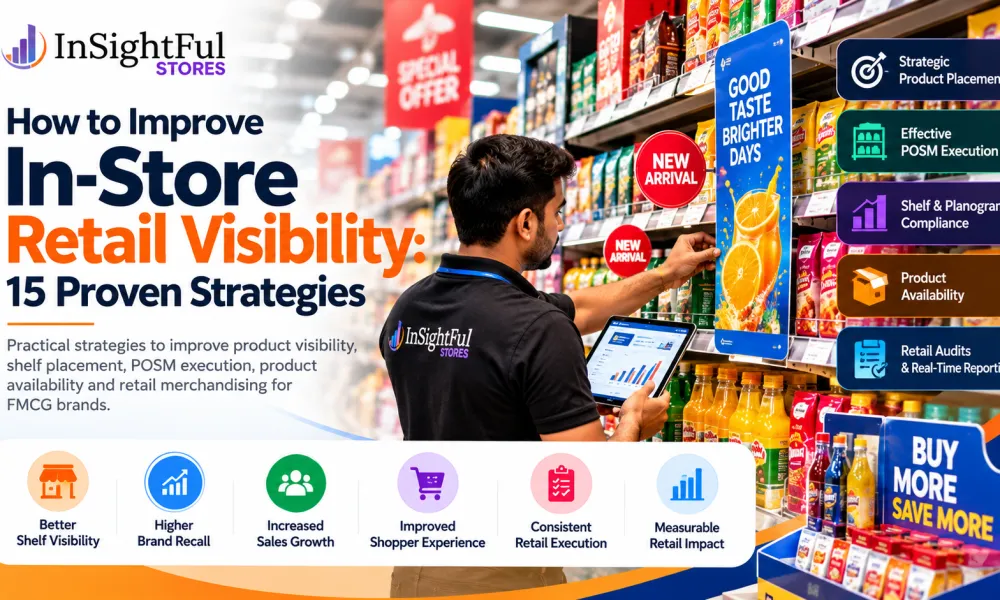
How to Improve In-Store Retail Visibility: 15 Proven Strategies for Retail Brands
Imagine walking into a supermarket with hundreds of products competing for attention.
Some brands occupy prominent shelf positions. Others have organized product displays, clear signage and consistent availability. Meanwhile, certain products remain difficult to find despite being stocked in the store.
This is one of the biggest challenges facing retail brands today.
Getting a product into a retail outlet is only the beginning. Ensuring that shoppers can find it easily, recognize it and access it when needed requires effective retail merchandising and store-level execution.
For FMCG, FMCD, consumer electronics, beauty and other consumer brands, in-store retail visibility is an important part of retail performance.
But how can brands improve visibility across hundreds or thousands of stores?
The answer involves more than attractive packaging or promotional materials.
Brands need a coordinated strategy covering product availability, shelf placement, merchandising compliance, point-of-sale materials, retail audits, field teams and technology.
In this guide, we explore how to improve in-store retail visibility through 15 practical strategies that help brands strengthen their physical retail presence and identify execution gaps.
What Is In-Store Retail Visibility?
In-store retail visibility refers to how easily shoppers can notice, identify and locate a brand's products within a physical retail store.
It depends on several factors, including:
Product availability
Shelf placement
Product facings
Shelf organization
Packaging visibility
Promotional displays
Point of Sale Materials (POSM)
Store layout
Retail merchandising execution
Competitor presence
For example, a product may be available in a supermarket but placed on a crowded lower shelf behind competing products.
Although the product is technically in stock, its visibility may be limited.
Conversely, a product with clear labeling, appropriate shelf placement and consistent availability may be easier for shoppers to locate.
Effective retail visibility combines product presence, discoverability and execution consistency.
Why Is In-Store Retail Visibility Important?
Retail brands invest in distribution, advertising, product development and consumer marketing.
However, these investments may deliver less value when shoppers cannot find products at the point of purchase.
Strong in-store visibility can support several business objectives.
1. Improve Product Discoverability
Well-organized shelves and clear product presentation make it easier for shoppers to locate relevant products.
2. Support Brand Recognition
Consistent packaging visibility and approved in-store communication can reinforce brand familiarity.
3. Reduce Missed Purchase Opportunities
When products are available and easy to locate, brands can reduce situations where shoppers cannot find the item they intended to purchase.
4. Strengthen Retail Execution
Visibility audits help brands identify merchandising gaps and maintain agreed retail standards.
5. Support Better Retail Decisions
Store-level visibility data helps brands understand which outlets, categories and territories require attention.
Importantly, visibility alone does not guarantee higher sales. Pricing, demand, product quality, availability and other factors also influence purchasing decisions.
15 Strategies to Improve In-Store Retail Visibility
1. Optimize Product Placement on Retail Shelves
Product placement is one of the most important elements of retail visibility.
Products positioned in easily accessible locations may be more noticeable than products placed in crowded or obstructed areas.
Brands should work with retailers to understand available shelf arrangements and placement guidelines.
Important considerations include:
Shelf height
Product accessibility
Category organization
Nearby competing products
Shelf depth
Product facings
Retailer-approved layouts
For example, a skincare brand may benefit from maintaining consistent product arrangements within the relevant skincare category.
However, placement decisions must respect retailer agreements and available shelf space.
Practical tip: Conduct regular shelf placement audits to identify products that are incorrectly positioned or difficult to locate.
2. Maintain Consistent Product Availability
A product cannot generate an in-store purchase when it is unavailable to shoppers.
Even a strong merchandising strategy can be undermined by stockouts.
Brands should monitor:
SKU availability
Shelf stock levels
Out-of-stock frequency
Replenishment requirements
Store-level inventory discrepancies
Distribution gaps
A key distinction is the difference between on-shelf availability and total store inventory.
A product may be missing from the shelf but available in the store's stockroom.
Regular merchandising visits and inventory reconciliation help identify these situations.
Practical tip: Prioritize stores with repeated stockouts and coordinate corrective action with the relevant retailer and distribution teams.
3. Follow Approved Planograms
A planogram is a visual representation of how products should be arranged on retail shelves.
It may define:
Product placement
SKU sequence
Number of facings
Shelf allocation
Category organization
Display structure
Planograms help brands and retailers maintain consistent shelf execution.
Without regular monitoring, actual store arrangements may gradually differ from approved layouts.
Field merchandisers can compare shelf conditions against the agreed planogram and report deviations.
Practical tip: Use reference images or digital planograms to simplify store-level compliance checks.
4. Increase Product Facings Where Commercially Appropriate
A product facing is one visible unit of a product presented toward the shopper.
For example, if four identical shampoo bottles are positioned side by side with their front labels visible, they represent four facings.
Brands can monitor the number of facings allocated to important SKUs.
However, increasing facings should be based on:
Product demand
Shelf capacity
Retailer agreements
Category performance
Inventory availability
Merchandising priorities
More facings are not automatically better if they displace higher-demand products or create inefficient shelf use.
Practical tip: Track facing compliance for priority SKUs and evaluate whether changes improve product accessibility and operational performance.
5. Use Effective POSM Printing and Management
Point of Sale Materials (POSM) can support product communication and in-store visibility.
Common POSM formats include:
Shelf strips
Danglers
Standees
Counter displays
Wobblers
Promotional posters
Floor graphics
Branded display units
Effective POSM execution requires more than printing materials.
Brands need a structured process for:
Design approval
Printing
Quality checks
Distribution
Store-level installation
Execution verification
Maintenance
Removal or replacement
A well-designed display that never reaches the intended store provides little operational value.
Practical tip: Monitor POSM installation compliance using field audits and authorized store photographs.
6. Improve Shelf Organization and Product Presentation
Poorly organized shelves can make products harder to locate.
Common problems include:
Misplaced products
Incorrect labels
Damaged packaging
Empty shelf spaces
Mixed product categories
Obstructed packaging
Inconsistent product arrangements
Retail merchandising teams can help maintain agreed shelf presentation standards.
For example, a beverage brand may establish a store-level checklist covering product alignment, label visibility and shelf condition.
Practical tip: Include shelf cleanliness, product alignment and label accuracy in regular merchandising audits.
7. Use Secondary Displays Strategically
Secondary displays are product presentation areas located outside a product's primary shelf position.
Depending on the retail format, these may include:
End-cap displays
Counter displays
Promotional islands
Freestanding display units
Seasonal display areas
Such displays can provide additional product exposure when permitted and agreed with the retailer.
Brands should consider store traffic patterns, available space, product relevance and display maintenance.
Practical tip: Measure secondary display installation and maintenance compliance rather than assuming that approved displays have been implemented correctly.
8. Conduct Regular Retail Visibility Audits
Retail visibility audits help brands understand how their products are presented across stores.
An audit may examine:
Product availability
Shelf placement
Product facings
Share of shelf
Planogram compliance
POSM installation
Packaging condition
Competitor presence
Display compliance
For large retail networks, standardized audit forms make results easier to compare.
Retail visibility audit workflow
Store Visit & Check-In
Product Availability Check
Shelf & Planogram Audit
POSM & Display Verification
Photo Documentation
Dashboard Reporting
Corrective Action & Re-Audit
Practical tip: Use the same core audit criteria across comparable store formats while allowing documented exceptions for different retailer requirements.
9. Deploy Trained Retail Merchandisers
Retail merchandisers help brands maintain execution standards across stores.
Depending on their assigned responsibilities, merchandisers may:
Check product availability
Verify shelf arrangements
Monitor POSM
Report stock gaps
Conduct retail audits
Document competitor presence
Coordinate with store personnel
Submit field reports
A structured merchandising program should include recruitment, training, store allocation, supervision and performance monitoring.
Practical tip: Train merchandisers on both brand standards and retailer-specific operating procedures.
10. Use Technology-Enabled Retail Execution Software
Managing hundreds of stores through manual spreadsheets and messaging applications can make execution difficult to monitor.
Retail execution software can help centralize field activities.
Common capabilities include:
Store mapping
Visit scheduling
Geo-tagged attendance
Digital audit forms
Product availability reporting
POSM monitoring
Stock observations
Photo documentation
Supervisor verification
Customized dashboards
Technology can help managers identify missed visits, incomplete audits and unresolved merchandising issues.
Practical tip: Select reporting tools based on the specific KPIs your merchandising teams need to monitor.
11. Use AI-Powered Image Recognition for Shelf Audits
Artificial intelligence and computer vision can support retail visibility analysis.
AI-enabled systems may identify products in store photographs and evaluate:
SKU presence
Product facings
Shelf allocation
Missing products
Planogram deviations
Display elements
For example, a field employee can capture an authorized shelf photograph through a mobile application.
A suitable computer vision model can analyze the image and flag potential merchandising issues.
However, AI recognition accuracy depends on image quality, product packaging, model training and store conditions.
Practical tip: Validate AI-generated findings against actual store conditions before using them for important operational decisions.
12. Monitor Competitor Shelf Presence
Understanding competitor activity can help brands evaluate their position within a retail category.
Where permitted, retail audits may record:
Competitor product presence
Number of facings
Shelf allocation
Display activity
Product assortment
New product introductions
Brands can compare these observations across stores and regions.
The objective is to understand actual retail conditions and identify operational priorities.
Practical tip: Use consistent measurement methods when comparing share of shelf across competing brands.
13. Customize Strategies for Modern Trade and General Trade
Retail visibility requirements differ between Modern Trade (MT) and General Trade (GT).
Modern Trade
Modern Trade stores often have standardized shelving, defined categories and structured merchandising guidelines.
Relevant activities include:
Planogram compliance
Shelf visibility audits
POSM execution
Product availability checks
Secondary display monitoring
General Trade
General Trade stores often have smaller spaces and less standardized layouts.
Relevant activities include:
Product availability monitoring
Appropriate product placement
Retailer coordination
Authorized visibility material checks
Store-level reporting
Factor | Modern Trade | General Trade |
|---|---|---|
Store layout | More standardized | Often varies |
Shelf planning | Formal planograms may apply | More flexible arrangements |
Display space | Defined fixtures | Frequently limited |
POSM | Structured approval processes | Outlet-specific permissions |
Audit approach | Detailed compliance checks | Adapted store-level checklists |
Practical tip: Avoid using exactly the same merchandising checklist for every retail format.
14. Track Retail Visibility KPIs
Retail visibility should be measured using clear performance indicators.
Important KPIs include:
KPI | What It Measures |
|---|---|
On-shelf availability | Percentage of required SKUs available on shelves |
Planogram compliance | Adherence to approved shelf layouts |
Share of shelf | Proportion of category shelf space occupied |
Product facing compliance | Actual facings versus agreed requirements |
POSM compliance | Approved materials correctly installed |
Store coverage | Percentage of assigned outlets visited |
Audit completion rate | Completed versus scheduled audits |
Issue closure rate | Percentage of identified problems resolved |
Stockout frequency | How often products are unavailable |
Reporting turnaround | Time between store visit and usable report |
Example: Measuring Retail Visibility Performance
Consider an illustrative retail audit covering 100 stores.
Stores with required SKUs available
82%
Stores meeting planogram standards
74%
Stores with correct POSM execution
68%
Stores with completed audits
95%
This example shows why brands should not evaluate merchandising performance using store coverage alone.
Even when 95% of scheduled audits are completed, the results may reveal significant gaps in POSM execution and planogram compliance.
Practical tip: Build dashboards that separate field activity completion from actual retail execution quality.
15. Build a Continuous Improvement Process
Retail visibility is not a one-time activity.
Shelf arrangements change, inventory fluctuates, promotional materials become damaged and new products enter stores.
Brands need a continuous process for maintaining execution standards.
A practical improvement cycle is:
Plan → Execute → Audit → Identify Gaps → Correct → Verify → Improve
For example, a regional manager may discover that certain stores repeatedly fail to maintain agreed shelf layouts.
Instead of recording the same problem every month, the team should investigate the cause.
Possible reasons may include:
Insufficient shelf capacity
Inadequate merchandiser training
Stock availability issues
Retailer restrictions
Incorrect reference layouts
Addressing the underlying cause is more useful than repeatedly reporting the same issue.
How to Create an Effective In-Store Retail Visibility Strategy
Brands can combine the 15 strategies into a structured implementation plan.
Step 1: Define Retail Visibility Objectives
Identify what the business wants to improve.
Examples include product availability, planogram compliance, shelf placement consistency or POSM execution.
Step 2: Segment Retail Outlets
Group stores by format, region, sales importance and merchandising requirements.
Step 3: Establish Baseline Performance
Conduct initial audits to understand current conditions.
Step 4: Define Execution Standards
Document agreed shelf arrangements, POSM requirements and audit criteria.
Step 5: Deploy Field Teams
Assign trained merchandisers and supervisors to relevant outlets.
Step 6: Implement Digital Reporting
Use standardized digital forms and dashboards to collect information.
Step 7: Review Performance
Monitor KPIs and identify recurring execution gaps.
Step 8: Verify Improvements
Conduct follow-up audits to confirm whether corrective actions have been completed.
Common Mistakes That Reduce In-Store Retail Visibility
Even established retail brands can experience execution gaps.
Common mistakes include:
Focusing only on distribution: A product being listed at a store does not guarantee that it is available or easy to locate.
Ignoring shelf availability: Stock may exist in the back room while shelves remain empty.
Poor POSM maintenance: Damaged or outdated materials can undermine display execution.
Inconsistent field reporting: Unstructured reports make performance comparisons difficult.
No corrective action tracking: Audits become less useful when identified issues remain unresolved.
Using the same strategy for every store: Retail formats have different layouts, customer needs and operating requirements.
Measuring visits instead of outcomes: Completing a store visit does not automatically mean that merchandising standards have been met.
How Technology Helps Improve Retail Visibility Across India
India's retail environment includes large supermarket chains, hypermarkets, specialty retailers and extensive General Trade networks.
For brands operating across multiple cities and states, monitoring store-level execution requires coordinated field operations.
Technology-enabled merchandising platforms can help management access information about:
Store coverage
Employee attendance
Product availability
Shelf compliance
POSM execution
Retail audit results
Regional performance
Outstanding corrective actions
This can help brands move from fragmented reporting toward more consistent retail execution management.
How Insightful Stores Supports Retail Merchandising and Visibility
Maintaining consistent retail visibility across a large store network requires a combination of trained manpower, structured execution processes and reliable reporting.
Insightful Stores provides managed retail and field-force services that support brands with store-level operations, merchandising and monitoring.
Its relevant service capabilities include:
Merchandiser recruitment and deployment
Field-force management
Store visit planning
Geo-tagged attendance
Product availability monitoring
Retail merchandising audits
Stock and sales reporting
POSM monitoring
Field supervision
Customized reporting dashboards
These capabilities can help brands coordinate merchandising activities across different retail formats.
Why Consider Insightful Stores for Retail Visibility Management?
Structured Merchandiser Deployment
Brands can coordinate field employees across assigned stores and territories.
Technology-Enabled Monitoring
Digital attendance and store reporting provide greater visibility into field activities.
Retail Execution Support
Structured merchandising visits can help identify product availability and display compliance gaps.
Centralized Reporting
Customized dashboards can make store-level observations easier to review.
Operational Accountability
Defined supervision and reporting processes help track execution activities and unresolved issues.
For FMCG, FMCD and other consumer brands, this integrated approach can support more consistent retail merchandising operations.
Future of In-Store Retail Visibility
Retail visibility management is increasingly connected with technology and data.
Potential developments include:
AI-assisted shelf image recognition
Automated planogram compliance checks
Real-time field reporting
Integrated inventory and retail execution data
Predictive identification of stockout risks
Automated issue assignment
Improved retail performance dashboards
However, technology alone cannot solve every store-level problem.
Brands still need trained employees, retailer coordination, accurate data and clear operating standards.
The strongest retail visibility programs combine people, processes, technology and measurable execution.
Understanding how to improve in-store retail visibility is essential for brands that want to strengthen their physical retail execution.
From shelf placement and product availability to POSM management, retail audits and field-force monitoring, every element contributes to how effectively products are presented in stores.
The most effective approach is not simply to increase the number of displays or store visits.
It is to ensure that products are available, merchandising standards are followed, execution gaps are identified and corrective actions are completed.
For brands operating across multiple retail locations, professional merchandising services and technology-enabled reporting can provide greater visibility into actual store conditions.
Looking for Retail Merchandising Solutions in India?
Insightful Stores helps brands manage retail merchandising, field-force deployment, store-level monitoring and technology-enabled reporting.
Whether your business operates in Modern Trade, General Trade or specialty retail, a structured execution program can help improve operational visibility across your retail network.
Connect with Insightful Stores to discuss your retail merchandising and store visibility requirements.
Frequently Asked Questions
How to improve in-store retail visibility?
Brands can improve in-store retail visibility by maintaining product availability, optimizing approved shelf placement, following planograms, using appropriate POSM, deploying trained merchandisers and conducting regular retail visibility audits.
What is in-store retail visibility?
In-store retail visibility refers to how easily shoppers can notice, recognize and locate products within a physical retail environment.
Why is product placement important in retail?
Product placement influences product accessibility and discoverability. Well-organized shelf arrangements help shoppers locate products more easily.
What is a retail visibility audit?
A retail visibility audit evaluates product availability, shelf placement, planogram compliance, POSM execution and other store-level merchandising conditions.
How does POSM improve retail visibility?
POSM can support product communication and display visibility through materials such as shelf strips, standees, counter displays and promotional signage.
What is share of shelf?
Share of shelf measures the proportion of category shelf space occupied by a brand. It may be calculated using product facings, shelf width or another defined measurement method.
How can AI improve in-store visibility?
AI-powered computer vision can assist with product recognition, shelf analysis, planogram compliance and detection of potential merchandising gaps.
What is the difference between Modern Trade and General Trade merchandising?
Modern Trade merchandising often follows structured planograms and standardized retail processes. General Trade merchandising typically requires more flexible store-level execution because outlet layouts vary.
What are the most important retail visibility KPIs?
Important KPIs include on-shelf availability, planogram compliance, share of shelf, product facing compliance, POSM compliance, store coverage and issue resolution rates.
How can brands monitor retail visibility across multiple stores?
Brands can use trained merchandising teams, standardized retail audits, digital store reporting, geo-tagged visits and centralized dashboards.