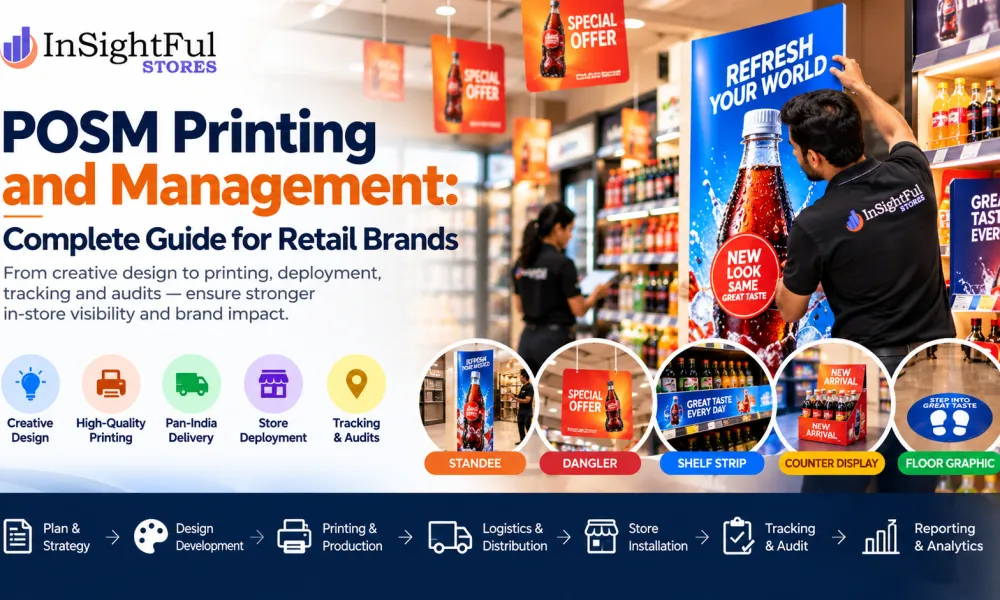
Walk into any supermarket, electronics store, pharmacy or retail outlet and you are surrounded by brands competing for one thing:
Shopper attention.
Some products are placed on regular shelves. Others are supported by eye-catching displays, shelf strips, standees, danglers, posters, counter units or branded display structures.
These materials are commonly known as POSM — Point of Sale Materials.
But creating an attractive POSM design is only one part of the process.
For a brand operating across hundreds or thousands of retail outlets, the bigger challenge is ensuring that the right materials are:
Designed → Printed → Delivered → Installed → Tracked → Maintained → Audited
That is where professional POSM printing and management becomes important.
A structured POSM program can help brands maintain consistent in-store visibility while gaining better control over production, deployment and retail execution.
What Is POSM?
POSM stands for Point of Sale Materials.
POSM refers to promotional and branding materials placed inside or around retail stores to attract shopper attention, communicate offers, improve product visibility and support purchase decisions.
Common POSM examples include:
- Posters
- Standees
- Danglers
- Shelf strips
- Shelf talkers
- Wobblers
- Countertop displays
- Floor-standing display units
- Display racks
- Product dispensers
- Tent cards
- Banners
- Window graphics
- Floor stickers
- Gondola branding
- End-cap displays
- Product display units
- Promotional kiosks
- Demo counters
Depending on the retail environment, POSM can range from a simple printed poster to a customized permanent display structure.
What Is POSM Printing and Management?
POSM printing and management is the end-to-end process of producing, deploying, installing, tracking, maintaining and auditing Point of Sale Materials across retail locations.
It goes beyond simply printing marketing materials.
A complete POSM management lifecycle can include:
Requirement Planning → Design Adaptation → Prototyping → Printing → Quality Control → Packaging → Logistics → Store Deployment → Installation → Tracking → Audit → Reporting
For large brands, centralizing this process can help maintain consistency across stores, cities and regions.
Why POSM Matters in Retail
Digital advertising may influence customers before they enter a store, but the final purchase decision often happens at or near the shelf.
At this stage, brands are competing with:
- Multiple competing products
- Promotional offers
- Retailer recommendations
- Shelf positioning
- Price differences
- Packaging
- Competitor displays
Effective POSM can help a product stand out within this crowded environment.
A strategically placed display can communicate:
What is the product?
Why should I consider it?
Is there an offer?
What makes it different?
POSM therefore acts as a communication layer between the brand and shopper at an important stage of the purchase journey.
Types of POSM Used by Retail Brands
Different retail objectives require different types of materials.
1. Posters
Posters are one of the simplest POSM formats and can be used for:
- New product launches
- Promotional offers
- Brand campaigns
- Seasonal communication
- Product awareness
They can be placed on walls, windows, pillars and other high-visibility locations.
2. Standees
Floor-standing promotional displays can attract shopper attention in entrances, aisles and promotional areas.
Standees are commonly used for:
- Product launches
- Offers
- Events
- Brand communication
- Campaign promotions
3. Shelf Strips
Shelf strips are placed along shelf edges to improve brand visibility directly where products are displayed.
They are particularly useful in crowded FMCG categories.
4. Shelf Talkers and Wobblers
These small shelf-level materials extend outward from the shelf and are designed to attract attention.
They can highlight:
- Discounts
- New launches
- Product benefits
- Offers
- Key differentiators
5. Danglers
Danglers are suspended from ceilings or fixtures and help brands communicate promotions above normal shelf level.
6. Countertop Display Units
Countertop units are positioned near checkout counters or service areas.
They can work particularly well for:
- Small products
- Impulse purchases
- Samples
- Promotional products
- New launches
7. Floor-Standing Display Units
FSDUs provide dedicated branded space for products.
They can combine:
Brand Visibility + Product Display + Promotional Communication
These units can be particularly useful for campaigns where brands want stronger presence outside the regular shelf.
8. Gondola and End-Cap Displays
End-cap locations often provide strong visibility because they face main store aisles.
Brands can use customized POSM around these areas to create dedicated promotional zones.
9. Floor Graphics
Floor stickers and graphics can direct shoppers toward:
- Products
- Promotional displays
- Launch areas
- Specific store sections
10. Window Branding
Retail windows can be used for:
- Campaign communication
- New launches
- Seasonal promotions
- Brand awareness
11. Promotional Kiosks
Kiosks provide dedicated areas for:
- Product demonstrations
- Sampling
- Customer engagement
- Lead generation
- Sales promotion
12. Permanent Display Units
Long-term display units can be created from materials such as:
- Metal
- Wood
- Acrylic
- Plastic
- MDF
These are generally used when brands require durable in-store branding rather than short-term promotional materials.
Temporary POSM vs Permanent POSM
An important decision is whether a campaign requires temporary or permanent POSM.
Temporary POSM
Temporary materials are typically used for:
- Short campaigns
- Product launches
- Seasonal promotions
- Sales offers
- Events
Examples include posters, danglers, cardboard displays and standees.
Permanent POSM
Permanent or semi-permanent displays are designed for longer use.
Examples include:
- Metal racks
- Wooden displays
- Acrylic units
- Branded shelves
- Permanent kiosks
The right option depends on campaign duration, retail environment, product category and budget.
The End-to-End POSM Printing and Management Process
Professional POSM management should cover the complete execution lifecycle.
1. Requirement Planning
Every POSM campaign should begin with clear requirements.
Important questions include:
- What is the campaign objective?
- Which products are being promoted?
- How many stores are involved?
- Which cities or regions are covered?
- What retail formats are involved?
- How long will the campaign run?
- What materials are required?
- Where will they be installed?
- What quantity is needed?
Clear planning helps reduce production and deployment errors later.
2. Store and Retail Environment Assessment
A POSM format that works in a hypermarket may not work in a small General Trade outlet.
Requirements can vary depending on:
- Store size
- Available space
- Shelf structure
- Customer traffic
- Retailer guidelines
- Installation restrictions
- Product category
Understanding the retail environment before mass production can improve execution quality.
3. Design Adaptation
Creative concepts often need to be adapted into different POSM formats.
A single campaign may require:
Poster + Standee + Shelf Strip + Wobbler + FSDU + Counter Display
Each format needs correct:
- Dimensions
- Branding
- Product imagery
- Offer communication
- Printing specifications
- Material selection
Consistency across these formats helps maintain a unified brand identity.
4. Prototyping
For customized displays, producing a prototype before mass production can be valuable.
Brands can evaluate:
- Dimensions
- Material
- Structural strength
- Print quality
- Product capacity
- Stability
- Visual appearance
- Installation requirements
Potential problems can therefore be identified before large-scale production.
5. POSM Printing
Once designs and specifications are approved, production begins.
Printing requirements vary depending on the material and intended use.
The objective should be to maintain:
- Brand consistency
- Accurate colours
- Clear graphics
- Correct dimensions
- Durable output
- Appropriate finishing
6. Quality Control
Producing thousands of units without proper quality checks can create expensive problems.
POSM quality control may verify:
- Print accuracy
- Colour consistency
- Dimensions
- Material quality
- Finishing
- Structural integrity
- Quantity
- Packaging
Quality control becomes particularly important for nationwide campaigns where materials are being distributed across multiple markets.
7. Packaging and Kitting
Different stores may require different combinations of materials.
Instead of shipping everything separately, materials can be organized into store-specific kits.
For example:
Store A Kit → 2 Posters + 4 Shelf Strips + 1 Standee + 10 Wobblers
Kitting can simplify distribution and reduce confusion during deployment.
8. Logistics and Distribution
Printing POSM is only useful if it reaches the right store at the right time.
POSM logistics may involve:
- Warehouse management
- City-wise allocation
- Store-wise allocation
- Dispatch
- Transportation
- Delivery tracking
- Receipt confirmation
For pan-India campaigns, logistics can become one of the most complex parts of POSM management.
9. Store-Level Installation
Delivery does not guarantee execution.
Materials must be installed correctly.
Field teams may be responsible for:
- Receiving POSM
- Coordinating with store personnel
- Installing materials
- Positioning displays
- Following brand guidelines
- Capturing execution photographs
- Reporting installation status
This is where POSM management becomes closely connected with retail execution.
10. POSM Tracking
Brands should know what happened after dispatch.
Important questions include:
Was the material delivered?
Was it installed?
Which store received it?
Is it still visible?
Was it damaged?
Was it removed?
Technology-enabled tracking can provide better visibility into the POSM lifecycle.
11. POSM Audit
Audits can verify whether the planned execution matches actual store conditions.
A POSM audit may check:
- Presence
- Correct installation
- Visibility
- Condition
- Placement
- Branding compliance
- Store compliance
- Competitor displays
Photographic reporting can provide additional evidence.
12. Reporting and Analytics
Management should receive structured information rather than hundreds of disconnected photographs.
Dashboards can potentially show:
- Materials produced
- Materials dispatched
- Stores covered
- Deliveries completed
- Installations completed
- Pending stores
- Damaged POSM
- Missing POSM
- Compliance percentage
- Region-wise execution
This creates a clearer view of campaign performance.
Why POSM Printing Alone Is Not Enough
One of the biggest mistakes brands can make is treating POSM as only a printing activity.
Imagine printing materials for 5,000 stores.
All materials leave the warehouse.
The printing vendor reports:
“100% dispatched.”
But the brand still does not know:
- How many stores received them?
- How many installed them?
- Were they installed correctly?
- Are they visible?
- Were some damaged?
- Did retailers remove them?
- Are competitors occupying better positions?
This creates an important distinction:
POSM Printing = Production
POSM Management = Production + Deployment + Verification + Tracking + Maintenance + Reporting
For large-scale retail campaigns, the second approach provides significantly greater operational visibility.
POSM Management in Modern Trade
Modern Trade stores can have strict guidelines around merchandising and promotional displays.
Execution may involve:
- Approved display locations
- End-cap branding
- Gondola branding
- Shelf strips
- Promotional displays
- FSDUs
- Product visibility
- Store approvals
Brands need to ensure that materials are not only delivered but executed according to retailer and brand requirements.
POSM Management in General Trade
General Trade presents a different challenge because stores can vary significantly in size and layout.
A standardized large display may not work across every outlet.
GT POSM can include:
- Posters
- Shop boards
- Shelf strips
- Counter displays
- Danglers
- Small product displays
- Window branding
Field teams may need to adapt execution according to the available retail space while maintaining brand guidelines.
POSM Printing and Management for FMCG Brands
FMCG brands often operate in highly competitive categories where multiple products fight for shelf visibility.
POSM can help support:
- New product launches
- Product trials
- Seasonal campaigns
- Promotional schemes
- Sampling activities
- Brand visibility
- Secondary displays
Combining POSM with trained promoters and merchandisers can further strengthen in-store execution.
POSM for Consumer Electronics and FMCD
Electronics and durable products often require larger displays and detailed communication.
Common POSM can include:
- Demo counters
- Product display units
- Specification cards
- Feature communication
- Kiosks
- Promotional standees
- Branded fixtures
Execution quality is particularly important because displays can directly influence how customers interact with products.
Technology-Enabled POSM Management
POSM operations traditionally rely heavily on spreadsheets, calls, emails and WhatsApp photographs.
Technology can create a more structured process.
A field application can allow teams to record:
Store Visit → POSM Availability → Installation → Geo-Tagged Photo → Condition → Compliance → Feedback → Submission
Management can then view information through centralized dashboards.
Technology-enabled POSM management can support:
- Geo-tagged execution
- Time-stamped visits
- Store-level tracking
- Photo verification
- Installation status
- POSM condition
- Audit forms
- Field-team monitoring
- Customized dashboards
This connects physical retail execution with digital reporting.
Role of Merchandisers in POSM Management
Merchandisers can play an important role after installation.
During regular store visits, they can verify:
- Whether POSM is still present
- Whether it is positioned correctly
- Whether materials are damaged
- Whether products are properly displayed
- Whether competitor materials have displaced the brand
- Whether replacement is required
This turns POSM from a one-time deployment activity into an ongoing retail execution process.
POSM Audit: Measuring What Actually Happened
A successful campaign should not be measured only by how many materials were printed.
More meaningful metrics include:
- Number of stores targeted
- Number of stores delivered
- Installation percentage
- Execution compliance
- POSM visibility
- Damaged material percentage
- Replacement rate
- Store coverage
- Photo compliance
- Audit compliance
This moves measurement from:
“How much POSM did we print?”
to:
“How effectively was POSM executed at retail?”
Important POSM Management KPIs
Brands can track KPIs such as:
Production Accuracy: Percentage of materials produced according to approved specifications.
On-Time Dispatch: Percentage dispatched according to schedule.
Delivery Rate: Percentage successfully delivered to targeted stores.
Installation Rate: Percentage of targeted stores where POSM was installed.
Execution Compliance: Percentage matching approved guidelines.
Photo Compliance: Percentage of executions supported by required photographs.
Damage Rate: Percentage requiring repair or replacement.
Replacement Turnaround Time: Time required to replace damaged or missing material.
Store Coverage: Percentage of targeted retail outlets successfully executed.
POSM Availability: Percentage of stores where materials remain present during subsequent audits.
Benefits of End-to-End POSM Printing and Management
A centralized approach can provide several advantages.
Consistent Brand Execution
Standardized production and guidelines help maintain visual consistency across locations.
Better Visibility
Brands can track what happens after materials leave the production facility.
Reduced Vendor Complexity
A single management structure can coordinate printing, logistics, installation and reporting.
Faster Execution
Structured workflows can reduce delays between production and store activation.
Improved Accountability
Store-level reporting creates clearer ownership across the execution chain.
Easier Scalability
A structured model makes it easier to expand campaigns across additional cities and stores.
Data-Driven Decisions
Dashboards and audits help identify markets where execution requires improvement.
Common POSM Management Challenges
Even well-designed campaigns can face operational challenges.
Delayed Production
Late approvals or production delays can affect campaign launch dates.
Incorrect Quantities
Poor allocation can lead to excess inventory in one market and shortages in another.
Logistics Delays
Materials may reach stores after the promotional campaign has already started.
Incorrect Installation
Even high-quality POSM can perform poorly if placed incorrectly.
Damaged Materials
Displays can become damaged during transportation, installation or regular store activity.
Lack of Visibility
Brands may know that materials were dispatched but not whether they were executed.
Retailer Restrictions
Stores may limit where or how promotional materials can be displayed.
A professional POSM management process should account for these risks before campaign rollout.
How to Choose a POSM Printing and Management Agency
Brands evaluating a POSM agency should look beyond printing prices.
Consider whether the partner can support the complete execution cycle.
Important capabilities include:
- Design adaptation
- Prototyping
- Printing
- Multi-material production
- Quality control
- Packaging
- Kitting
- Warehousing
- Pan-India logistics
- Store deployment
- Installation
- Field-force management
- POSM audits
- Geo-tagged reporting
- Photo verification
- Technology
- Dashboards
- Replacement management
A vendor that only prints materials may solve the production requirement.
A POSM management agency should help solve the broader retail execution requirement.
POSM Printing Company vs POSM Management Agency
Although the terms are sometimes used interchangeably, there is an important difference.
A POSM printing company primarily focuses on producing physical promotional materials.
A POSM management agency can coordinate the wider lifecycle, including production, logistics, installation, tracking, auditing and reporting.
For smaller campaigns, printing services may be sufficient.
For brands executing campaigns across hundreds or thousands of stores, an integrated POSM management model can provide greater visibility and accountability.
How AI and Computer Vision Could Transform POSM Audits
POSM management is also moving toward more data-driven verification.
Traditionally, managers may need to manually review thousands of store photographs.
Computer vision has the potential to assist with tasks such as:
- Detecting whether POSM is present
- Identifying display types
- Checking product presence
- Comparing planned vs actual displays
- Detecting missing branding elements
- Measuring execution consistency
A future workflow could look like:
Field Visit → Geo-Tagged Photo → AI Analysis → Compliance Score → Dashboard → Corrective Action
Human verification will remain important, but technology can make large-scale retail auditing more efficient.
Insightful Stores for POSM Printing and Management
For brands running retail campaigns across multiple markets, managing POSM separately from field execution can create operational gaps.
Insightful Stores can support a more integrated approach by connecting POSM execution with field-force and retail operations.
Depending on the campaign requirements, the model can bring together:
- POSM planning
- Production coordination
- Printing
- Deployment
- Store-level execution
- Merchandiser support
- Promoter support
- Retail audits
- Field monitoring
- Store-level reporting
- Technology-enabled tracking
- Customized dashboards
This creates a connected workflow:
Plan → Produce → Dispatch → Deploy → Install → Verify → Audit → Report → Optimize
Instead of evaluating success only through production quantities, brands can gain greater visibility into actual retail execution.
The Future of POSM Is Measurable Retail Execution
POSM is evolving from a largely production-focused activity into a measurable part of retail execution.
The old approach asks:
How many units did we print?
The more useful questions are:
Where were they deployed?
Did they reach the correct stores?
Were they installed?
Were they positioned correctly?
Are they still visible?
Are they in good condition?
How does execution vary by city or region?
Where do we need corrective action?
The future of POSM management lies in connecting physical branding + field execution + technology + retail data.
POSM remains an important part of physical retail marketing because it allows brands to communicate with shoppers close to the point of purchase.
But effective POSM requires much more than attractive design and high-quality printing.
For large retail programs, success depends on managing the complete lifecycle:
Planning → Printing → Quality Control → Distribution → Installation → Tracking → Auditing → Reporting
A structured POSM printing and management strategy can help brands maintain consistent visibility, reduce execution gaps and gain greater control over campaigns across stores and markets.
For FMCG, FMCD, consumer electronics, beauty, food & beverage and other retail-focused businesses, integrating POSM management with field operations and technology can transform promotional materials from a printing expense into a measurable retail execution program.
Looking for POSM Printing and Management Services in India?
Insightful Stores supports brands with technology-enabled retail and field execution across multiple markets.
For businesses looking to manage POSM at scale, an integrated approach can bring together printing, deployment, field execution, tracking, audits and reporting under a more structured operating model.
Connect with Insightful Stores to discuss a POSM printing and management program tailored to your brand, retail network and campaign requirements.
Frequently Asked Questions About POSM Printing and Management
What does POSM mean?
POSM stands for Point of Sale Materials. These are promotional and branding materials placed at retail locations to attract shopper attention, communicate product information and support purchase decisions.
What is POSM printing and management?
POSM printing and management covers the end-to-end process of producing, distributing, installing, tracking, maintaining and auditing Point of Sale Materials across retail stores.
What are examples of POSM?
Common examples include posters, standees, danglers, shelf strips, wobblers, countertop units, floor-standing displays, kiosks, gondola displays, window graphics and branded racks.
What is a POSM management agency?
A POSM management agency coordinates multiple stages of POSM execution, which can include production, quality control, logistics, deployment, installation, field verification, audits and reporting.
Why is POSM important for FMCG brands?
FMCG products often compete with many alternatives on the same shelf. POSM can help increase product visibility, communicate promotions and support shopper engagement at the point of purchase.
How can brands track POSM execution?
Brands can use field applications, geo-tagged visits, time-stamped photographs, digital audit forms and centralized dashboards to monitor POSM delivery, installation, condition and compliance.
What is a POSM audit?
A POSM audit verifies whether promotional materials are present, correctly installed, visible, in good condition and compliant with the brand's execution guidelines.
What is the difference between POSM and merchandising?
POSM refers primarily to promotional and branding materials used at the point of sale. Merchandising is broader and includes product placement, shelf arrangement, availability, displays, planograms and overall presentation. POSM is often one component of a larger merchandising strategy.