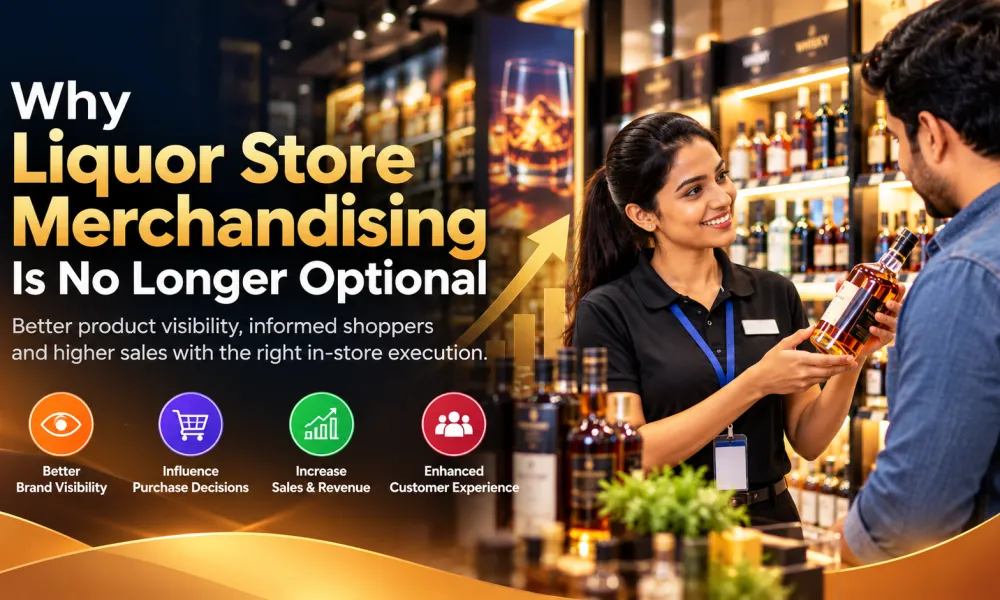
A great product and strong marketing campaign can bring
customers into a store. But what happens when they reach the point of purchase?
Who explains the product?
Who demonstrates its benefits?
Who communicates ongoing offers?
Who answers customer questions?
And most importantly, who converts shopper interest into a
purchase?
This is where trained in-store promoters and Brand Advisors
become important.
For brands operating across hundreds or thousands of retail
outlets, however, recruiting and deploying promoters is only the beginning.
Managing attendance, training, performance, payroll, replacements and reporting
across multiple locations can quickly become complex.
A professional promoter management agency helps
brands manage this entire lifecycle through structured manpower management,
field operations and technology-enabled monitoring.
What Is a Promoter Management Agency?
A promoter management agency is a specialized partner
that recruits, trains, deploys, monitors and manages in-store promoters and
Brand Advisors on behalf of brands.
Depending on the campaign, promoters may work across:
- Supermarkets
- Hypermarkets
- Modern
Trade stores
- General
Trade outlets
- Electronics
stores
- Shopping
malls
- Department
stores
- Exhibitions
- Events
- Product
launches
- Sampling
campaigns
- Brand
activations
Instead of coordinating different vendors for recruitment,
training, attendance, payroll and reporting, brands can work with one promoter
management partner responsible for the complete operation.
What Does a Promoter Do in Retail?
An in-store promoter acts as the direct connection between a
brand and the shopper.
The promoter's responsibilities can vary by industry and
campaign but typically include:
- Greeting
potential customers
- Explaining
products and features
- Demonstrating
products
- Communicating
promotions and schemes
- Answering
customer questions
- Encouraging
product trials
- Supporting
purchase decisions
- Collecting
customer feedback
- Tracking
sales
- Monitoring
stock availability
- Reporting
competitor activities
- Maintaining
brand presentation
- Submitting
daily activity reports
A well-trained promoter is therefore much more than
additional manpower inside a store.
The promoter represents the brand at one of the most
important stages of the customer journey—the point of purchase.
Why Brands Need Professional Promoter Management
Managing five or ten promoters may be relatively
straightforward.
Managing hundreds or thousands of promoters across multiple
cities, states, retail chains and store formats is a completely different
challenge.
Brands can face issues such as:
- High
promoter attrition
- Absenteeism
- Delayed
replacements
- Inconsistent
training
- Poor
product knowledge
- Incorrect
deployment
- Limited
attendance visibility
- Manual
reporting
- Payroll
complications
- Inconsistent
customer experience
- Difficulty
measuring promoter performance
A structured promoter management agency helps
centralize these operations and gives brands greater visibility into their
field workforce.
End-to-End Promoter Management Process
Professional promoter management should cover the complete
employee lifecycle rather than simply supplying manpower.
1. Promoter Recruitment
Successful promoter management starts with recruiting the
right people.
Candidates may be evaluated based on:
- Communication
skills
- Relevant
experience
- Product
category knowledge
- Sales
aptitude
- Personality
- Grooming
- Language
proficiency
- Location
- Retail
experience
- Customer-handling
ability
Recruitment criteria should also vary according to the
product.
A promoter representing an electronics brand, for example,
may require different skills from someone handling food sampling or
personal-care products.
2. Screening and Selection
Recruitment volume alone does not guarantee quality.
Candidates need to be screened against the brand's
requirements before deployment.
A structured selection process can help ensure that
promoters match the intended role, store environment and customer profile.
This reduces the risk of deploying unsuitable resources
simply to fill vacancies.
3. Product and Sales Training
A promoter cannot effectively sell a product they do not
understand.
Training should therefore cover areas such as:
- Product
features
- Product
benefits
- Key
differentiators
- Pricing
- Current
promotions
- Competitor
comparison
- Customer
objections
- Sales
communication
- Store
etiquette
- Brand
guidelines
Regular refresher training can also help promoters remain
updated when products, pricing or campaigns change.
4. Strategic Promoter Deployment
The next challenge is getting the right promoter to the
right store.
Deployment decisions can consider:
- Store
location
- Expected
footfall
- Product
category
- Sales
potential
- Promoter
experience
- Language
requirements
- Retail
format
- Campaign
priorities
Effective deployment ensures that manpower investment is
aligned with business opportunities rather than simply filling positions.
5. Attendance & Real-Time Monitoring
For brands managing large field teams, knowing whether
promoters actually reached their assigned stores is critical.
Technology-enabled promoter management can provide greater
visibility through:
- Geo-tagged
attendance
- Check-in
and check-out
- Store-level
location verification
- Working
hours
- Daily
activities
- Leave
management
- Visit
history
Real-time monitoring reduces dependency on manual attendance
sheets and gives managers better visibility into field operations.
6. Promoter Performance Management
Attendance alone does not determine whether a promoter is
effective.
Brands should also measure performance.
Depending on the campaign, promoter KPIs may include:
- Sales
achieved
- Target
achievement
- Customer
interactions
- Product
demonstrations
- Samples
distributed
- Conversion
rate
- Working
hours
- Store
coverage
- Customer
feedback
- Stock
reporting
- Visibility
reporting
- Attendance
compliance
These metrics help identify high-performing promoters as
well as locations where additional support or training may be needed.
7. Payroll & Incentive Management
Managing salaries and incentives across a large field
workforce can become operationally challenging.
A promoter management agency can centralize:
- Attendance
validation
- Salary
processing
- Incentive
calculations
- Expense
management
- Performance-linked
payouts
- Payment
records
A structured process improves transparency for both brands
and field employees.
8. Replacement & Attrition Management
Attrition is one of the biggest challenges in field-force
management.
When a promoter leaves unexpectedly, an important retail
location can remain unattended.
Professional promoter agencies therefore need strong
sourcing networks and replacement processes.
The objective should be to minimize downtime and ensure
continuity at important stores.
9. Daily Reporting and Dashboards
Brands need more than attendance data.
Management teams need actionable information.
Promoter management dashboards can provide visibility into:
- Active
promoters
- Attendance
percentage
- Store
coverage
- Sales
- Target
achievement
- Product
availability
- Stock
levels
- Customer
interactions
- Promoter
productivity
- Expenses
- Regional
performance
Instead of manually consolidating spreadsheets from
different locations, decision-makers can view structured information through
centralized dashboards.
How Technology Is Changing Promoter Management
Traditional promoter management relied heavily on phone
calls, WhatsApp groups, spreadsheets and manual attendance.
This approach becomes increasingly difficult as field-force
size grows.
Modern promoter management solutions can use mobile
applications, geo-tagging, automated reporting and dashboards to create greater
transparency.
A promoter application can allow field employees to record:
Attendance → Store Visit → Sales → Stock → Customer
Interaction → Feedback → Expenses → Daily Reporting
The same information can then be made available to
supervisors and brand managers through dashboards.
This creates a connected system between field execution and
management.
Promoter Management for FMCG Brands
For FMCG companies, promoters can influence purchase
decisions in categories where shoppers have multiple alternatives.
A trained FMCG promoter can:
- Explain
product benefits
- Introduce
new products
- Conduct
sampling
- Communicate
promotional schemes
- Encourage
product trials
- Track
availability
- Collect
consumer feedback
- Support
visibility execution
- Report
competitor activity
Promoter management therefore becomes closely connected with
overall retail execution.
Promoter Management for FMCD & Consumer Electronics
FMCD and electronics products often require more detailed
product explanation.
Consumers may compare specifications, prices, warranties and
features before purchasing.
Brand Advisors and In-Store Promoters can help customers
understand these differences.
For these categories, training becomes especially important
because incorrect information can negatively affect both sales and customer
trust.
Promoter Management in Modern Trade & General Trade
A strong promoter management strategy should adapt to
different retail environments.
Modern Trade
Promoters working in Modern Trade environments may focus on:
- Consumer
engagement
- Product
demonstrations
- Sales
conversion
- Sampling
- Promotional
communication
- Stock
availability
- Competitor
tracking
- Daily
sales reporting
General Trade
General Trade execution may require a more distributed field
structure and stronger local market coordination.
Depending on the program, responsibilities can include:
- Outlet
coverage
- Product
visibility
- Retailer
interaction
- Scheme
communication
- Stock
checks
- Promotional
execution
- Field
reporting
The management approach therefore needs to be flexible
enough to support different channels.
How to Choose the Right Promoter Management Agency
When evaluating a promoter management agency in India,
brands should look beyond the cost per promoter.
Consider the following capabilities:
Strong Recruitment Network
Can the agency recruit quality promoters across your
required markets?
Training Capabilities
Does it provide structured product, sales and behavioural
training?
Pan-India Coverage
Can the agency execute campaigns consistently across cities
and states?
Technology
Does it provide real-time attendance, geo-tagging and field
tracking?
Performance Monitoring
Can you measure individual and store-level promoter
performance?
Payroll Management
Can the agency efficiently handle salaries, incentives and
expenses?
Replacement Capability
How quickly can absent or exited promoters be replaced?
Customized Reporting
Can dashboards and reports be adapted to your KPIs?
Retail Experience
Does the agency understand Modern Trade, General Trade and
different product categories?
Single-Partner Management
Can one agency handle recruitment, training, deployment,
monitoring, payments and reporting?
These factors become especially important when managing
large field teams.
Benefits of Working With a Promoter Management Agency
Outsourcing promoter operations to a specialized partner can
help brands achieve:
Better scalability: Expand promoter teams across
markets without building a large internal operational structure.
Improved accountability: Technology-based attendance
and reporting provide better field visibility.
Consistent training: Standardized training helps
maintain brand communication across locations.
Faster recruitment: Established sourcing networks can
help fill vacancies more efficiently.
Reduced operational complexity: One partner can
coordinate multiple manpower-management functions.
Better performance visibility: Dashboards help
identify strong and weak stores, markets and promoters.
Greater management control: Centralized reporting
provides decision-makers with a clearer view of field operations.
Important KPIs for Promoter Management
Promoter programs should be evaluated using measurable KPIs.
Important metrics can include:
- Promoter
attendance rate
- Store
coverage
- Sales
per promoter
- Target
achievement percentage
- Consumer
interactions
- Demonstrations
conducted
- Conversion
rate
- Product
availability
- Attrition
rate
- Replacement
turnaround time
- Training
completion
- Reporting
compliance
- Promoter
productivity
The exact KPIs should depend on the campaign's business
objectives.
Insightful Stores as a Promoter Management Agency
Insightful Stores provides end-to-end managed
services for brands requiring promoters, Brand Advisors, ISPs, merchandisers
and other field resources across India.
Rather than focusing only on manpower deployment, Insightful
Stores' model covers the complete management lifecycle:
Recruitment → Training → Deployment → Real-Time
Monitoring → Operational Management → Reporting
Promoters and Brand Advisors are professionally trained and
groomed, while technology provides brands with greater visibility into their
field teams.
The company's proprietary application supports functions
including attendance management, store management, sales, stock tracking,
customer interactions, customer feedback, visibility, PJP management, travel
and expense management.
Customized dashboards further allow brands to access
performance information based on their business requirements.
This combination of trained manpower + field operations +
technology + analytics creates a more structured approach to promoter
management.
Why Insightful Stores for Large-Scale Promoter
Management?
Managing a nationwide promoter program requires scale,
systems and execution capabilities.
Insightful Stores combines field-force management with
in-house technology and retail expertise across FMCG and FMCD categories.
Its managed-services approach is designed to support:
- Promoter
and Brand Advisor recruitment
- Professional
training
- Pan-India
deployment
- Real-time
field monitoring
- Store-level
reporting
- Performance
tracking
- Payroll
and payment management
- Operational
supervision
- Customized
dashboards
- Technology-enabled
execution
For brands that require large promoter teams across multiple
markets, this integrated model can simplify field-force operations by bringing
multiple functions under one management structure.
The Future of Promoter Management Is Data-Driven
Promoter management is evolving from a manpower-driven
activity into a technology-enabled retail function.
Brands increasingly want to know more than:
“How many promoters have we deployed?”
They want answers to:
Where are they working?
Are they attending stores consistently?
How many customers are they interacting with?
What are they selling?
Which stores are performing best?
Where are we losing sales opportunities?
Which promoters need additional training?
The future of promoter management lies in connecting people,
technology, retail data and performance analytics.
Final Thoughts
Promoters represent a brand at one of the closest possible
points to the customer.
Managing them effectively therefore requires much more than
recruitment.
Successful promoter programs require the right people,
proper training, strategic deployment, real-time monitoring, performance
management, accurate payments and actionable reporting.
A professional promoter management agency brings
these functions together, helping brands manage field teams more consistently
and at greater scale.
For FMCG, FMCD and other retail-focused businesses operating
across multiple stores and markets, technology-enabled promoter management can
transform a fragmented field operation into a structured and measurable retail
execution program.
Looking for a Promoter Management Agency in India?
Insightful Stores provides end-to-end promoter and
Brand Advisor management solutions covering recruitment, training, deployment,
real-time tracking, operational management and customized reporting.
Connect with Insightful Stores to build a promoter
management program customized to your brand, retail network and business
objectives.