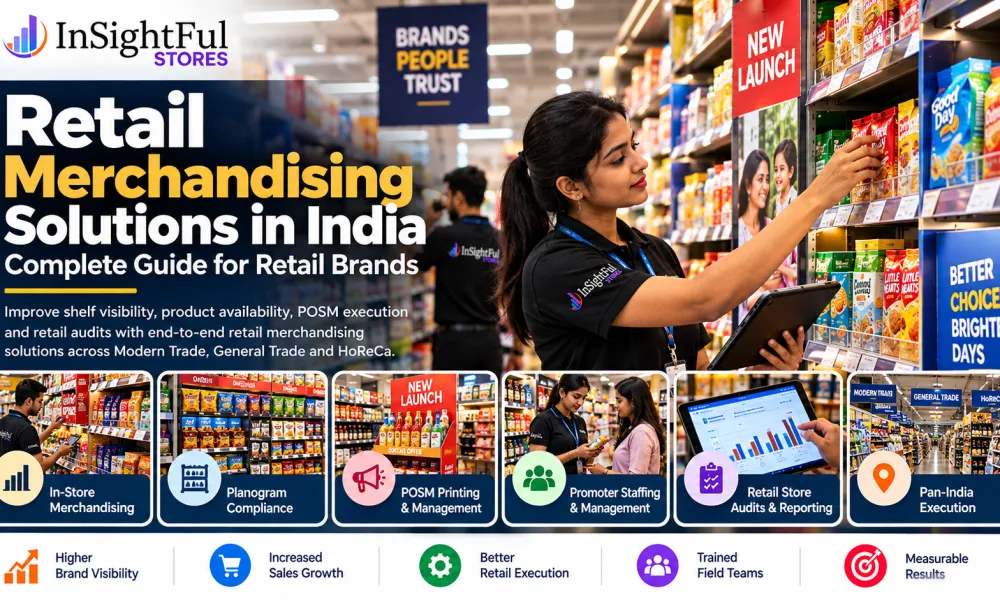
Retail Merchandising Solutions: A Complete Guide for Retail Brands in India
A product can be distributed to thousands of retail stores and still struggle to reach its sales potential.
The reason is simple: distribution does not automatically guarantee effective in-store execution.
Products may be placed on the wrong shelves, important SKUs may remain unavailable, promotional materials may not be installed correctly, and store-level merchandising standards may vary across locations.
For FMCG, FMCD, electronics, beauty, personal care and other consumer brands, these challenges can affect product discoverability, operational efficiency and the overall shopping experience.
This is where retail merchandising solutions play an important role.
Modern retail merchandising combines trained field teams, product availability monitoring, shelf management, POSM execution, retail audits and technology-enabled reporting to help brands maintain a consistent retail presence.
For businesses operating across multiple cities, retail formats and distribution channels in India, a structured merchandising program can make store-level execution easier to monitor and improve.
This guide explains what retail merchandising solutions are, how they work, their benefits, key services, relevant technologies and how to choose the right merchandising partner.
What Are Retail Merchandising Solutions?
Retail merchandising solutions are professional services, processes and technologies used to manage how products are stocked, organized, displayed and monitored inside retail stores.
They help brands maintain agreed merchandising standards, identify execution gaps and coordinate corrective actions across their retail networks.
Retail merchandising solutions commonly include:
Shelf management and product arrangement
Product availability and stock monitoring
Planogram implementation
Point of Sale Materials (POSM) management
Visual merchandising
Retail store audits
Competitor visibility monitoring
Field merchandiser recruitment and deployment
Digital store visit reporting
Retail execution dashboards
The objective is to improve the consistency, visibility and accountability of store-level operations.
Why Are Retail Merchandising Solutions Important?
Retail brands invest heavily in product development, distribution, advertising and trade marketing.
However, these investments may deliver less value when retail execution is inconsistent.
For example, a brand may secure distribution across 500 outlets, but only 350 stores may have all priority SKUs available on the shelf.
In this situation, the brand's distribution footprint is larger than its actual on-shelf availability.
A structured merchandising program can help identify and address such gaps.
Key Benefits of Retail Merchandising Solutions
1. Better Product Visibility
Organized shelves, approved product placement and appropriate display materials can make products easier for shoppers to locate.
2. Improved Product Availability
Regular stock checks help identify missing SKUs, shelf gaps and replenishment requirements.
3. Consistent Brand Presentation
Standardized merchandising processes help maintain agreed display arrangements across retail locations.
4. Stronger Retail Execution
Trained merchandisers can identify and report store-level execution problems.
5. Better Operational Visibility
Digital reporting provides management teams with more consistent information about store conditions.
6. More Efficient Field Operations
Structured store visits, employee allocation and supervision can help reduce operational inefficiencies.
10 Essential Retail Merchandising Solutions for Modern Brands
1. In-Store Merchandising Services
In-store merchandising involves organizing and maintaining products within physical retail outlets.
Professional merchandisers may support:
Product arrangement
Shelf replenishment coordination
Product facing checks
Shelf label verification
Packaging condition inspections
Store-level reporting
Retailer coordination
The scope of work depends on the retailer's permissions and the brand's merchandising requirements.
For example, an FMCG brand may deploy merchandisers to monitor priority SKUs across supermarket outlets.
Field teams can identify misplaced products, check shelf availability and report operational issues.
Business benefit: More consistent merchandising execution across assigned stores.
2. Planogram Implementation and Compliance
A planogram is a visual reference showing how products should be arranged on retail shelves.
It may define product sequence, shelf allocation, number of facings and category placement.
Planogram compliance helps brands and retailers compare actual store arrangements with approved standards.
A merchandising team can:
Review the approved planogram.
Visit the assigned store.
Inspect the relevant shelf.
Identify deviations.
Document observations.
Coordinate authorized corrections.
Verify completion.
For large retail networks, digital planogram references and standardized audit forms can improve reporting consistency.
Business benefit: Better alignment between agreed shelf plans and actual store execution.
3. Product Availability and Stock Monitoring
A product cannot be purchased when it is unavailable.
Product availability monitoring helps brands identify stock-related issues at the store level.
Common activities include:
SKU availability checks
Shelf stock observations
Out-of-stock reporting
Inventory discrepancy identification
Replenishment coordination
Slow-moving stock observations
Damaged product reporting
Brands should distinguish between products missing from the shelf and products unavailable throughout the store.
A SKU may be present in the stockroom but absent from the shelf.
Business benefit: Earlier identification of availability gaps and replenishment requirements.
4. POSM Printing, Deployment and Management
Point of Sale Materials (POSM) support in-store product communication and display execution.
Common POSM formats include:
Shelf strips
Standees
Danglers
Wobblers
Counter displays
Floor graphics
Promotional posters
Display units
A complete POSM management process includes design approval, printing, quality inspection, distribution, installation, verification and maintenance.
Simply delivering POSM to a store does not guarantee that it has been installed correctly.
Field teams can verify execution through authorized photographs and digital audit reports.
Business benefit: Better control over approved in-store display execution.
5. Retail Store Audit Services
Retail audits help brands evaluate merchandising conditions across their retail networks.
A typical retail merchandising audit may cover:
Audit Area | What Is Checked |
|---|---|
Product availability | Presence of required SKUs |
Shelf placement | Products positioned according to approved layouts |
Planogram compliance | Adherence to agreed arrangements |
POSM execution | Correct installation of approved materials |
Product condition | Packaging damage or visible defects |
Price labels | Accuracy of required shelf information |
Competitor visibility | Observable competitor shelf presence |
Store reporting | Completion and quality of audit records |
Digital audit systems can make results easier to compare across stores, territories and reporting periods.
Business benefit: Improved visibility into actual retail execution conditions.
6. Modern Trade Merchandising Solutions
Modern Trade includes organized retail formats such as supermarkets, hypermarkets and retail chains.
These outlets often have standardized shelving, defined category arrangements and formal merchandising requirements.
Modern Trade merchandising services may include:
Planogram compliance
Product availability monitoring
Shelf management
Secondary display checks
POSM verification
Retail audit reporting
Store coordination
Brands operating across multiple retail chains may need retailer-specific merchandising procedures.
Business benefit: More consistent execution across organized retail outlets.
7. General Trade Merchandising Solutions
General Trade includes traditional retail formats such as kirana stores and independent outlets.
These stores often differ in size, shelf arrangements and available display space.
General Trade merchandising may focus on:
Product availability
Outlet coverage
Appropriate product placement
Retailer coordination
Authorized visibility material checks
Stock observations
Store-level reporting
Because store layouts vary, merchandising processes should be flexible while maintaining consistent reporting standards.
Business benefit: Better visibility into execution across distributed traditional retail networks.
8. Visual Merchandising Solutions
Visual merchandising focuses on how products and displays are presented in the retail environment.
Depending on the category and store format, it may include:
Product grouping
Shelf organization
Display arrangements
Category signage
Promotional fixtures
Product presentation standards
Seasonal displays
For example, an electronics brand may use approved demonstration areas to organize products and communicate key features.
Visual merchandising should align with retailer permissions, product requirements and brand guidelines.
Business benefit: Clearer product presentation and a more organized shopping environment.
9. Retail Field-Force Management
Large merchandising programs require effective coordination of field employees.
Field-force management may include:
Merchandiser recruitment
Training and onboarding
Store allocation
Attendance monitoring
Shift scheduling
Field supervision
Performance reporting
Replacement coordination
Issue escalation
Technology-enabled systems can help managers track assigned store visits and employee activities.
Business benefit: Improved operational accountability across merchandising teams.
10. Technology-Enabled Retail Execution Solutions
Technology is increasingly important for managing merchandising operations across multiple locations.
Retail execution platforms may support:
Geo-tagged store visits
Digital audit forms
Photo documentation
Product availability reporting
POSM compliance tracking
Supervisor verification
Issue management
Customized dashboards
Regional performance reporting
Advanced systems may also use AI-powered image recognition to assist with shelf audits and product identification.
However, such capabilities should be evaluated individually rather than assumed to be included in every merchandising platform.
Business benefit: More consistent data collection and better monitoring of retail execution.
How Retail Merchandising Solutions Work
A successful merchandising program requires a structured process from planning to performance evaluation.
Retail merchandising execution workflow
Retail Network Assessment
Store Segmentation & Planning
Merchandiser Recruitment & Training
Store Visits & Merchandising Execution
Digital Audits & Photo Reporting
Performance Review & Issue Identification
Corrective Actions & Re-Audits
Each stage should have clear responsibilities, measurable standards and reporting requirements.
Retail Merchandising Solutions for Different Industries
Retail merchandising requirements vary by product category.
Industry | Key Merchandising Priorities |
|---|---|
FMCG | Product availability, shelf facings, replenishment, POSM |
FMCD | Product presentation, display compliance, stock visibility |
Consumer electronics | Display units, demo readiness, product information |
Beauty and personal care | Category organization, tester condition, product availability |
Food and beverages | Stock rotation, availability, display maintenance |
Fashion and apparel | Visual merchandising, size availability, display standards |
Home appliances | Product presentation, demo areas, inventory checks |
Specialty retail | Category-specific displays, product information, store audits |
Brands should tailor merchandising checklists and reporting systems to their product categories and retail formats.
Modern Trade vs General Trade Merchandising
Factor | Modern Trade | General Trade |
|---|---|---|
Retail format | Supermarkets, hypermarkets, chains | Kirana and independent stores |
Shelf layout | Often standardized | Frequently varies |
Planograms | Commonly used | May be less formal |
POSM deployment | Structured approval processes | Outlet-specific permissions |
Store coverage | Defined chain networks | Widely distributed outlets |
Reporting | Detailed compliance reporting | Flexible store-level reporting |
Merchandiser requirements | Retailer-specific procedures | Adaptable field execution |
A strong retail merchandising partner should be able to design appropriate processes for both formats.
How to Measure Retail Merchandising Performance
Brands should define key performance indicators before starting a merchandising program.
Important Retail Merchandising KPIs
KPI | Measurement |
|---|---|
Store coverage | Completed visits ÷ planned visits × 100 |
On-shelf availability | Available required SKUs ÷ total required SKUs checked × 100 |
Planogram compliance | Compliant shelf checks ÷ applicable shelf checks × 100 |
POSM compliance | Correctly executed displays ÷ required displays × 100 |
Product facing compliance | Actual facings compared with agreed requirements |
Issue closure rate | Resolved issues ÷ total identified issues × 100 |
Audit completion rate | Completed audits ÷ scheduled audits × 100 |
Reporting turnaround | Time between store visit and report submission |
Merchandiser attendance | Completed assigned shifts ÷ scheduled shifts × 100 |
Example: Retail Merchandising Performance Dashboard
Consider a hypothetical FMCG merchandising program covering 200 retail outlets.
Store visit completion
95%
On-shelf availability
88%
Planogram compliance
79%
POSM compliance
73%
Issue closure rate
84%
This example illustrates why store coverage alone is not enough to evaluate merchandising quality.
Even with a high visit completion rate, a brand may still have significant gaps in planogram and POSM compliance.
Common Retail Merchandising Challenges in India
1. Inconsistent Store Execution
Brands may find that merchandising standards differ across outlets and territories.
Solution: Use standardized checklists, approved reference layouts and regular field audits.
2. Product Stockouts
Products may be unavailable because of replenishment delays or inventory discrepancies.
Solution: Monitor on-shelf availability and coordinate corrective action with supply chain teams.
3. Limited Field Visibility
Managing merchandisers across multiple cities can be difficult without centralized reporting.
Solution: Implement digital attendance, store visit tracking and field supervision.
4. Poor POSM Execution
Approved materials may remain uninstalled, become damaged or be removed.
Solution: Track installation, maintenance and replacement through structured reporting.
5. High Field Employee Turnover
Frequent employee changes can affect continuity and training.
Solution: Establish structured recruitment, onboarding, training and replacement processes.
6. Incomplete Retail Data
Inconsistent spreadsheets and informal reporting make performance comparisons difficult.
Solution: Use standardized digital audit forms and dashboards.
How AI Is Transforming Retail Merchandising Solutions
Artificial intelligence can support selected merchandising activities through image recognition, analytics and workflow automation.
Potential applications include:
AI-Powered Shelf Recognition
Computer vision systems can analyze authorized shelf images to identify products and estimate shelf presence.
Automated Planogram Checks
Image analysis can assist in comparing shelf arrangements against reference layouts.
Product Availability Detection
AI may help flag products that appear to be missing from visible shelf areas.
Retail Audit Automation
AI-assisted workflows can reduce selected manual reporting tasks.
Predictive Analytics
With suitable historical data, predictive models can help identify stores or SKUs at higher risk of stockouts.
These technologies require reliable data, suitable image quality and human verification.
Brands should assess accuracy, cost and implementation requirements before deployment.
How to Choose the Right Retail Merchandising Solutions Provider in India
Selecting a merchandising partner is an important operational decision.
Before choosing an agency, evaluate the following factors.
Industry Experience
Does the provider understand the merchandising requirements of your product category?
Geographic Coverage
Can the agency support the cities, states and retail networks relevant to your business?
Recruitment and Training
Does the provider have structured processes for hiring and training merchandisers?
Technology Capabilities
Can the provider support digital attendance, retail audits and customized reporting?
Supervision and Quality Control
How are field activities verified and operational issues escalated?
Reporting Transparency
Will the brand receive clear store-level performance data?
Scalability
Can the provider expand or adjust deployment according to changing business requirements?
Commercial Structure
Are recruitment, staffing, management, travel and technology costs clearly defined?
Brands should also request relevant case studies, references and service-level commitments.
How Insightful Stores Supports Retail Merchandising Solutions in India
For brands operating across large retail networks, managing merchandising teams internally can require significant coordination.
Insightful Stores provides technology-enabled retail and field-force management services that can support store-level merchandising operations.
Relevant capabilities include:
Retail merchandiser recruitment and deployment
Field-force management
Store visit planning
Geo-tagged attendance monitoring
Product availability reporting
POSM execution monitoring
Retail audits
Field supervision
Stock and sales reporting
Customized reporting dashboards
These services can help brands coordinate field activities and maintain better visibility into merchandising execution across assigned outlets.
Why Consider Insightful Stores?
Structured field operations: Coordinate merchandisers across stores and territories.
Technology-enabled reporting: Collect standardized field information through digital processes.
Retail execution support: Monitor shelf availability, merchandising activities and store-level issues.
Customized reporting: Align dashboards and operational KPIs with business requirements.
Field supervision: Improve accountability through defined monitoring and escalation procedures.
Specific service coverage, technology features and deployment arrangements should be confirmed during project scoping.
Retail Merchandising Solutions vs Traditional Merchandising
Traditional merchandising often relies on manual store visits, paper-based reports and decentralized communication.
Modern merchandising programs may combine field teams with digital tools.
Area | Traditional Approach | Technology-Enabled Approach |
|---|---|---|
Store visits | Manual records | Digital visit logs |
Attendance | Paper registers | Geo-tagged attendance |
Retail audits | Paper checklists | Digital audit forms |
Photo reporting | Disconnected images | Organized store-level records |
Issue tracking | Calls and messages | Centralized issue logs |
Reporting | Periodic spreadsheets | Dashboards and structured reports |
Performance analysis | Manual consolidation | Faster data aggregation |
Technology can improve reporting consistency, but successful execution still depends on trained employees and effective retailer coordination.
Future Trends in Retail Merchandising Solutions
Retail merchandising is becoming more data-driven as brands seek better visibility into store-level conditions.
Important developments include:
AI-assisted retail audits
Automated planogram analysis
Real-time field reporting
Integrated inventory and merchandising data
Predictive stockout monitoring
Mobile-first field-force platforms
Digital corrective action tracking
More detailed retail performance dashboards
The future of merchandising is likely to involve closer coordination between field employees, retailers, supply chain teams and technology platforms.
Effective retail merchandising solutions help brands bridge the gap between product distribution and actual store-level execution.
From shelf management and product availability to POSM deployment, retail audits and field-force monitoring, each activity contributes to maintaining a consistent retail presence.
For FMCG, FMCD and other consumer brands operating across India, a structured merchandising strategy can improve operational visibility and help identify issues before they become recurring problems.
The most effective approach combines trained field teams, standardized processes, technology-enabled reporting and measurable performance indicators.
By working with a suitable retail merchandising partner, brands can coordinate store execution more efficiently and make better-informed retail decisions.
Looking for Retail Merchandising Solutions in India?
Insightful Stores supports brands with retail merchandising, field-force deployment, store-level monitoring and technology-enabled reporting.
Whether your business operates in Modern Trade, General Trade or specialty retail, a tailored merchandising program can help strengthen retail execution across your network.
Contact Insightful Stores to discuss your retail merchandising requirements.
Frequently Asked Questions
What are retail merchandising solutions?
Retail merchandising solutions are services, processes and technologies used to manage product availability, shelf arrangements, displays, retail audits and field merchandising activities across physical stores.
Why are retail merchandising services important for FMCG brands?
They help FMCG brands monitor product availability, maintain agreed shelf standards, verify POSM execution and identify store-level merchandising gaps.
What does a retail merchandising agency do?
A retail merchandising agency may provide trained merchandisers, store visits, shelf management, product availability checks, retail audits and reporting services.
What is the difference between retail merchandising and visual merchandising?
Retail merchandising covers broader store execution activities such as product availability, shelf management and retail audits. Visual merchandising focuses more specifically on how products and displays are presented.
What are Modern Trade merchandising solutions?
Modern Trade merchandising solutions support organized retail formats through planogram checks, shelf management, product availability monitoring and standardized retail audits.
What are General Trade merchandising solutions?
General Trade merchandising solutions support traditional retail outlets through product availability checks, retailer coordination, outlet coverage and adaptable store-level reporting.
How can technology improve retail merchandising?
Technology can support geo-tagged attendance, digital store visits, photo documentation, merchandising audits, issue tracking and performance dashboards.
Can AI automate retail merchandising audits?
AI-powered image recognition can assist with product identification, shelf analysis and planogram compliance checks. Human verification is still important.
What KPIs should retail brands track?
Important KPIs include on-shelf availability, planogram compliance, POSM execution, store coverage, audit completion, product facing compliance and issue closure rates.
How do I choose a retail merchandising agency in India?
Evaluate industry experience, geographic coverage, recruitment capabilities, field supervision, reporting technology, scalability, references and commercial transparency.