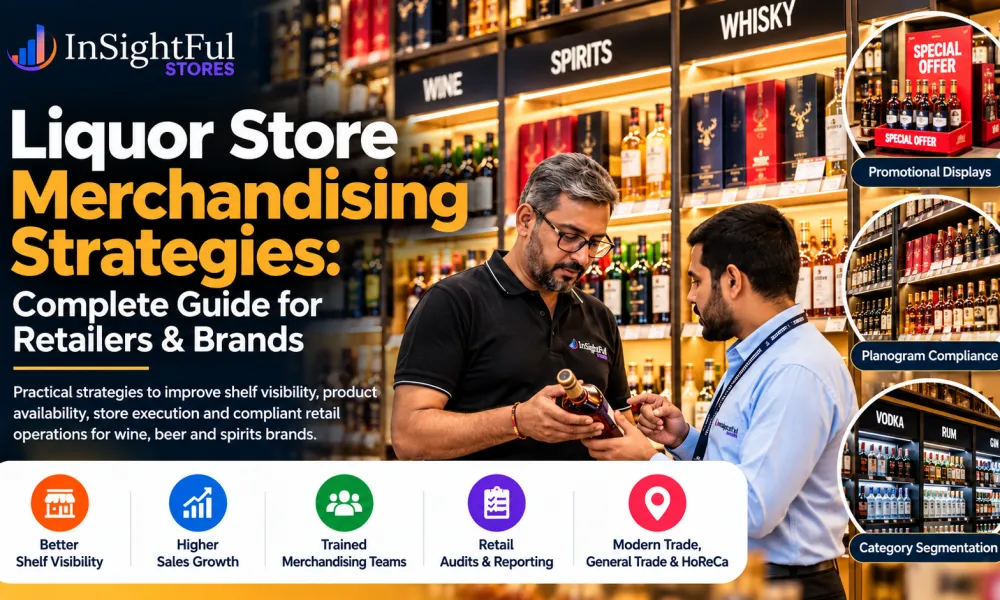
Liquor Store Merchandising Strategies: A Complete Guide to Better Retail Execution
The alcoholic beverage industry operates in a retail environment where product availability, shelf organization, inventory accuracy and regulatory compliance all matter.
Unlike conventional FMCG retail, liquor stores must operate within licensing requirements, state-specific excise regulations and restrictions on product promotion and display.
For liquor retailers and alcoholic beverage brands, maintaining consistent store execution can be challenging, especially across multiple locations.
A product may be listed at a store but unavailable on the shelf. Inventory records may not match actual stock. Shelf arrangements may vary between outlets, and field teams may struggle to collect consistent information.
These challenges highlight the importance of structured liquor store merchandising strategies.
Effective liquor store merchandising is not simply about making products more noticeable. It involves maintaining accurate product information, ensuring appropriate storage, organizing authorized product displays, monitoring inventory and verifying compliance with retail operating standards.
For businesses managing multiple licensed outlets, combining merchandising processes with digital retail audits can improve operational visibility and accountability.
What Are Liquor Store Merchandising Strategies?
Liquor store merchandising strategies are the operational methods used to organize, monitor and maintain alcoholic beverage products within licensed retail environments while following applicable laws and retailer requirements.
These strategies can include:
Product categorization and shelf organization
Stock availability monitoring
Inventory accuracy checks
Product condition inspections
Approved planogram implementation
Price-label verification
Shelf and storage maintenance
Retail compliance audits
Field merchandiser deployment
Digital store reporting
Corrective action management
The objective is to help retailers and brand operations teams maintain consistent, compliant and measurable store execution.
Why Is Liquor Store Merchandising Important?
Liquor retail operations can involve hundreds of SKUs, multiple suppliers, different product formats and complex inventory requirements.
Without standardized merchandising processes, retailers may encounter:
Inaccurate inventory records
Missing or misplaced products
Incorrect shelf labels
Damaged packaging
Inconsistent store layouts
Delayed replenishment
Incomplete retail audit records
Difficulties comparing store performance
A structured merchandising approach helps reduce these operational gaps.
It also enables retail managers to identify issues systematically rather than relying entirely on occasional manual inspections.
12 Liquor Store Merchandising Strategies for Retail Operations
1. Organize Products Using a Consistent Category Structure
A consistent product categorization system helps retailers maintain orderly shelves and accurate inventory records.
Stores may organize products by categories such as whisky, rum, vodka, gin, wine, beer and other approved product classifications.
Within each category, retailers can use internal product codes, package sizes and stock-keeping units (SKUs) to maintain accurate records.
A standardized category structure helps staff locate products, perform stock checks and identify misplaced inventory.
For multi-store operators, consistent categorization also makes reporting and inventory reconciliation easier.
2. Implement Approved Shelf Layouts and Planograms
A planogram provides a reference for how products should be arranged within a retail fixture.
In licensed liquor stores, planograms should reflect applicable display regulations, available space and retailer-approved operating standards.
An internal planogram may specify:
Product category locations
SKU placement
Shelf capacity
Package-size organization
Storage restrictions
Product handling requirements
Field teams can compare actual shelf arrangements against approved reference layouts.
This helps identify misplaced products, inconsistent arrangements and operational deviations.
3. Monitor Product Availability at Store Level
Product availability monitoring helps retail operators understand whether listed SKUs are physically present.
Regular checks can identify:
Missing products
Low stock levels
Unrecorded stock movement
Delayed replenishment
Differences between shelf and back-room inventory
Discontinued or inactive SKUs
Store-level observations should be reconciled with inventory management systems where available.
A shelf photograph alone cannot establish total store inventory, so physical checks and stock records remain important.
4. Maintain Accurate Shelf Labels and Price Information
Price-label accuracy is an important operational and compliance requirement.
Depending on applicable state regulations, liquor retailers may need to follow specific rules regarding declared prices, maximum retail prices, product information and permitted signage.
Routine checks should verify that:
Labels correspond to the correct products
Required information is visible
Prices match authorized records
Outdated labels have been removed
Store records reflect current approved information
Any pricing discrepancy should be escalated through the retailer's compliance process.
5. Inspect Product and Packaging Condition
Damaged packaging can create handling, inventory and customer-service problems.
Store teams should inspect products for issues such as:
Broken seals
Leaking containers
Damaged cartons
Illegible labels
Missing identification information
Improper storage conditions
Products with suspected quality or regulatory issues should be isolated and handled according to applicable procedures.
6. Improve Inventory Rotation and Stock Handling
Inventory rotation is important for products with relevant shelf-life, storage or batch-management requirements.
Retailers can establish procedures for:
Batch identification
Receipt-date recording
Expiry or best-before checks where applicable
Stock reconciliation
Storage-condition monitoring
Damaged-stock documentation
The appropriate rotation method depends on the product category and manufacturer requirements.
7. Standardize Store-Level Merchandising Checklists
A structured checklist ensures that different employees evaluate stores using consistent criteria.
For example, a liquor store merchandising checklist may include:
Audit Area | Verification |
|---|---|
Product availability | Are listed SKUs physically available? |
Shelf organization | Are products in approved locations? |
Price labels | Is required information accurate? |
Packaging condition | Are containers and labels intact? |
Inventory records | Do recorded quantities match stock? |
Storage conditions | Are relevant handling requirements followed? |
Store compliance | Are required operating standards met? |
Issue reporting | Are exceptions documented and escalated? |
Digital checklists can make information easier to compare across locations.
8. Conduct Regular Retail Visibility and Compliance Audits
Retail audits help managers verify whether stores are operating according to approved standards.
Audits may cover:
Product presence
Shelf arrangement
Inventory accuracy
Label compliance
Product condition
Storage practices
Store documentation
Corrective action status
The scope should be defined according to retailer policies and applicable state laws.
9. Use Technology-Enabled Field Reporting
Managing multiple retail outlets through disconnected spreadsheets and messages can make reporting difficult.
Digital field reporting systems can support:
Assigned store visits
Geo-tagged check-ins
Digital audit forms
Authorized photo documentation
Issue reporting
Supervisor verification
Centralized dashboards
This allows management teams to access more consistent store-level information.
10. Train Merchandising Teams on Compliance and Store Procedures
Merchandising employees should understand both operational requirements and relevant regulatory restrictions.
Training may cover:
Store visit procedures
Product handling
Inventory checks
Approved shelf layouts
Audit documentation
Retailer permissions
Data confidentiality
Incident escalation
Training should be updated when operating procedures or applicable regulations change.
11. Track Corrective Actions Instead of Only Recording Problems
Identifying an issue is only the first stage of retail auditing.
A structured corrective action process should document:
The problem identified
The affected store
The responsible team
The required corrective action
The expected resolution date
Verification of completion
For example, if an audit identifies an incorrect shelf label, the issue should remain open until the retailer verifies that the label has been corrected.
12. Measure Merchandising Performance Through KPIs
Retail operators need measurable indicators to understand whether merchandising processes are improving.
Useful KPIs include:
KPI | Purpose |
|---|---|
Store audit completion | Tracks completed versus planned audits |
SKU availability | Measures presence of required products |
Inventory accuracy | Compares recorded and actual stock |
Planogram compliance | Measures adherence to approved layouts |
Label accuracy | Tracks correct product information |
Damaged-stock rate | Measures damaged inventory |
Issue closure rate | Tracks corrective action completion |
Audit turnaround time | Measures reporting speed |
Field visit compliance | Tracks assigned store visits |
KPIs should be tailored to the store format, product assortment and compliance requirements.
How to Build a Liquor Store Merchandising Plan
A practical merchandising plan should connect operating standards with regular verification.
Retail merchandising implementation workflow
Review State Regulations & Retailer Permissions
Map Stores, Categories & SKUs
Define Approved Shelf & Inventory Standards
Train Field Teams & Assign Visits
Conduct Store-Level Audits
Review Digital Reports & Exceptions
Implement & Verify Corrective Actions
The process should be reviewed periodically as retail operations, product assortments and regulations change.
Common Liquor Store Merchandising Challenges
Inconsistent Store Layouts
Different stores may have different fixture sizes and storage arrangements. Standardized processes should therefore allow for documented, retailer-approved variations.
Inventory Discrepancies
Differences between recorded and physical stock can affect replenishment and reporting. Regular reconciliation helps identify these gaps.
Limited Field Visibility
Management teams may struggle to verify activities across geographically dispersed outlets. Digital visit records and structured audits can improve oversight.
Regulatory Differences Across States
Indian states have different alcohol retail frameworks. A process approved in one state should not automatically be applied in another.
Incomplete Reporting
Photographs and informal messages may not provide enough information for management decisions. Structured audit forms and issue tracking help create more useful records.
Role of AI in Liquor Store Merchandising Audits
Artificial intelligence and computer vision may help automate selected retail audit activities.
For example, where image capture and processing are authorized, computer vision can assist with:
Product recognition
SKU identification
Shelf arrangement analysis
Missing-product detection
Packaging-condition flags
Comparison with approved shelf layouts
A possible workflow is:
Authorized Store Visit → Shelf Image Capture → AI Analysis → Human Verification → Audit Report
AI findings should be treated as decision-support information rather than definitive proof of compliance.
Poor lighting, partially hidden products and similar packaging can affect recognition accuracy.
How Insightful Stores Can Support Liquor Retail Merchandising
Managing merchandising across multiple outlets requires trained field teams, standardized processes and reliable reporting.
Insightful Stores provides technology-enabled retail and field-force management services that can support structured store-level operations.
For Alcobev-related engagements, a tailored scope may include:
Field merchandiser deployment
Store visit planning
Product availability reporting
Authorized retail audits
Digital attendance monitoring
Store-level data collection
Field supervision
Customized reporting dashboards
Issue tracking and corrective action coordination
All activities should be defined according to applicable laws, retailer permissions and the brand's compliance requirements.
Conclusion
Effective liquor store merchandising strategies depend on operational consistency, accurate inventory information, trained field teams and regulatory compliance.
By implementing standardized shelf layouts, product availability checks, inventory reconciliation, digital retail audits and corrective action tracking, licensed retailers can improve visibility into day-to-day store operations.
For businesses managing multiple outlets, combining professional field merchandising with technology-enabled reporting can create a more structured and accountable retail execution process.
Looking for Liquor Store Merchandising Solutions in India?
Insightful Stores supports brands with retail field-force management, merchandising operations and technology-enabled reporting.
Connect with Insightful Stores to discuss compliant retail merchandising and store audit requirements for your business.
Frequently Asked Questions
What are liquor store merchandising strategies?
Liquor store merchandising strategies are processes used to manage product organization, availability, inventory accuracy, shelf layouts and store-level compliance in licensed alcohol retail environments.
Why is merchandising important in liquor stores?
Merchandising helps retailers maintain orderly product presentation, accurate information, appropriate stock handling and consistent store operations.
What is a liquor store merchandising audit?
A liquor store merchandising audit checks whether product availability, shelf arrangements, inventory information and operating practices follow approved standards.
Can AI be used for liquor store merchandising?
Yes. Where permitted, AI-powered image analysis can assist with product recognition, shelf checks and audit reporting. Human verification remains important.
What is the difference between liquor merchandising and FMCG merchandising?
Both involve stock and shelf management, but liquor merchandising must account for additional alcohol-specific licensing, excise and promotional restrictions.
How can liquor retailers improve inventory accuracy?
Retailers can improve inventory accuracy through regular stock counts, inventory reconciliation, documented stock movement and structured exception reporting.
What does a liquor store merchandising agency do?
A merchandising agency may coordinate trained field teams, store visits, authorized audits, inventory observations and retail reporting.
Are alcohol promotional displays allowed in India?
Permissions vary by state, location, activity and applicable law. Businesses should obtain appropriate legal review before deploying promotional materials or displays.